
|
You entered: image
 APOD: 2023 April 19 Б Auroral Storm over Lapland
19.04.2023
On some nights the sky is the best show in town. On this night, auroras ruled the sky, and the geomagnetic storm that created this colorful sky show originated from an increasingly active Sun.
 APOD: 2023 November 7 Б A Martian Dust Devil Spins By
7.11.2023
It moved across the surface of Mars -- what was it? A dust devil. Such spinning columns of rising air are heated by the warm surface and are also common in warm and dry areas on planet Earth.
 Simulation: Two Black Holes Merge
10.05.2024
Relax and watch two black holes merge. Inspired by the first direct detection of gravitational waves in 2015, this simulation plays in slow motion but would take about one third of a second if run in real time. Set on a cosmic stage, the black holes are posed in front of stars, gas, and dust.
 IFN and the NGC 7771 Group
31.08.2024
Galaxies of the NGC 7771 Group are featured in this intriguing skyscape. Some 200 million light-years distant toward the constellation Pegasus, NGC 7771 is the large, edge-on spiral near center, about 75,000 light-years across, with two smaller galaxies below it. Large spiral NGC 7769 is seen face-on to the right.
 Apollo 17 s Moonship
14.12.2024
Awkward and angular looking, Apollo 17's lunar module Challenger was designed for flight in the near vacuum of space. Digitally enhanced and reprocessed, this picture taken from Apollo 17's command module America shows Challenger's ascent stage in lunar orbit.
 Jupiter: When Storms Collide
22.10.1998
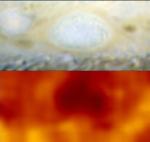
Sometime in February, two of three long-lived Jovian storm systems known as "white ovals" apparently collided and merged -- forming what is now likely the second largest storm in the Solar System, after the famous Great Red Spot.
 The Planetary Nebula Show
3.10.2001
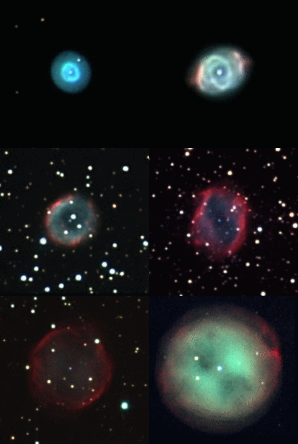
What do the Owl, the Cat's Eye, the Ghost of Jupiter, and Saturn have in common? They're all planetary nebulae of course(!), glowing gaseous shrouds shed by dying sun-like stars as they run out of nuclear fuel.
 The Galactic Center A Radio Mystery
3.08.2002
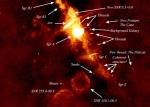
Tuning in to the center of our Milky Way galaxy, radio astronomers explore a complex, mysterious place. A premier high resolution view, this startlingly beautiful picture covers a 4x4 degree region around the galactic center.
 Mir is 10
10.03.1996
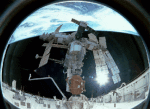
The first module of the Russian Space Agency's Mir Space Station was launched into orbit 10 years ago (on February 20, 1986). Mir has since been substantially expanded in orbit by adding additional modules including the Kvant Astrophysics Module (1987) and recently a docking module.
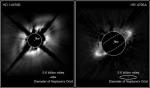 Possible Planets And Infrared Dust
20.01.1999
These near-infrared Hubble images of dust surrounding young stars offer the latest tantalizing evidence for planets beyond our Solar System. At left, the dark gap seen in the dust disk is reminiscent of a similar large gap in Saturn's rings believed to be sculpted by orbiting moons.
|
January February March April May June July August September |
|||||||||||||||||||||||||||||||||||||||||||||||||