
|
You entered: image
 APOD: 2025 January 12 Б Mimas: Small Moon with a Big Crater
11.01.2025
Whatever hit Mimas nearly destroyed it. What remains is one of the largest impact craters on one of Saturn's smallest round moons. Analysis indicates that a slightly larger impact would have destroyed Mimas entirely.
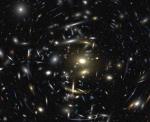 Simulated Galaxy Cluster View
5.03.2002
Stunningly detailed, this picture is a computer simulated view of a cluster of galaxies in the distant cosmos. A large, elliptical galaxy dominates this hypothetical cluster's central region surrounded by a swarm of member galaxies.
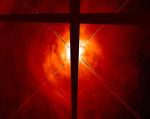 AB Aurigae: How To Make Planets
7.02.2003
This enhanced Hubble Space Telescope image shows in remarkable detail the inner portion of the disk of dust and gas surrounding the star AB Aurigae. Knots of material, visible here for the first time...
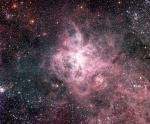 The Tarantula Zone
23.08.2003
The Tarantula Nebula is more than 1,000 light-years across - a giant emission nebula within our neighboring galaxy the Large Magellanic Cloud. Inside this cosmic arachnid lies a central young cluster of massive stars, cataloged as R136, whose intense radiation and strong winds have helped energize the nebular glow and shape the spidery filaments.
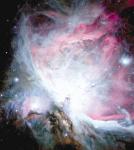 The Orion Nebula from CFHT
14.03.2004
Few astronomical sights excite the imagination like the nearby stellar nursery known as the Orion Nebula. The Nebula's glowing gas surrounds hot young stars at the edge of an immense interstellar molecular cloud only 1500 light-years away.
 AE Aurigae: The Flaming Star
18.10.2005
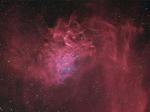
Is star AE Aurigae on fire? No. Even though AE Aurigae is named the flaming star, the surrounding nebula IC 405 is named the Flaming Star Nebula, and the region appears to harbor red smoke, there is no fire.
 The Sloan Great Wall: Largest Known Structure
6.11.2007
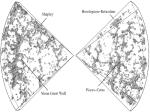
What is the largest structure known? The answer might depend on how one defines "structure." A grouping of galaxies known as the Sloan Great Wall was discovered in the Sloan Digital Sky Survey and is a leading candidate.
 Black Holes in Merging Galaxies
29.05.2010
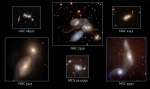
Violent galaxy mergers can feed supermassive black holes. Theoretically, the result is intense emission from regions near the supermassive black holes, creating the some of the most luminous objects in the universe. Astronomers dub these Active Galactic Nuclei, or just AGN.
 Comet Garradd and Messier 15
6.08.2011
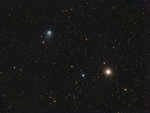
Recorded on August 2, this telescopic composite image catches Comet Garradd (C/2009 P1) in the same field of view as globular star cluster M15. The celestial scene would have been a rewarding one for influential 18th century comet hunter Charles Messier.
 Asteroids Near Earth
1.10.2011
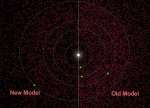
Though the sizes are not to scale, the Sun and planets of the inner solar system are shown in this illustration, where each red dot represents an asteroid. New results from NEOWISE, the infrared...
|
January February March April May June July August September |
|||||||||||||||||||||||||||||||||||||||||||||||||