
|
You entered: emission
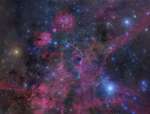 Vela Supernova Remnant
6.03.2008
The plane of our Milky Way Galaxy runs through this complex and beautiful skyscape. At the northwestern edge of the constellation Vela (the Sails) the 16 degree wide, 30 frame mosaic is centered on the glowing filaments of the Vela Supernova Remnant, the expanding debris cloud from the death explosion of a massive star.
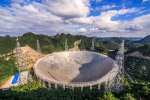 Five Hundred Meter Aperture Spherical Telescope
29.09.2016
The Five-hundred-meter Aperture Spherical Telescope (FAST) is nestled within a natural basin in China's remote and mountainous southwestern Guizhou province. Nicknamed Tianyan, or the Eye of Heaven, the new radio telescope is seen in this photograph taken near the start of its testing phase of operations on September 25.
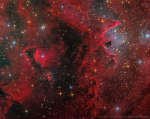 IC 1871: Inside the Soul Nebula
28.11.2018
This cosmic close-up looks deep inside the Soul Nebula. The dark and brooding dust clouds on the left, outlined by bright ridges of glowing gas, are cataloged as IC 1871. About 25 light-years across, the telescopic field of view spans only a small part of the much larger Heart and Soul nebulae.
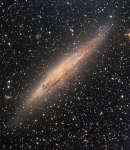 Nearby Spiral Galaxy NGC 4945
26.02.2022
Large spiral galaxy NGC 4945 is seen nearly edge-on in this cosmic galaxy close-up. It's almost the size of our Milky Way Galaxy. NGC 4945's own dusty disk, young blue star clusters, and pink star forming regions stand out in the colorful telescopic frame.
 APOD: 2024 February 14 Б Rosette Deep Field
14.02.2024
Can you find the Rosette Nebula? The large, red, and flowery-looking nebula on the upper left may seem the obvious choice, but that is actually just diffuse hydrogen emission surrounding the Cone and Fox Fur Nebulas.
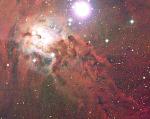 The Fox Fur Nebula
1.07.2002
The nebula surrounding bright star S Mon is filled with dark dust and glowing gas. The strange shapes that surrounding this star originate from fine interstellar dust reacting in complex ways with the energetic light and hot gas being expelled by the young stars.
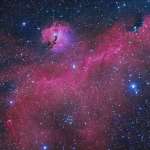 The Seagull Nebula
12.01.2011
This broad expanse of glowing gas and dust presents a bird-like visage to astronomers from planet Earth, suggesting its popular moniker - The Seagull Nebula. This portrait of the cosmic bird covers a 1.6 degree wide swath across the plane of the Milky Way, near the direction of Sirius, alpha star of the constellation Canis Major.
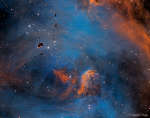 Stars and Globules in the Running Chicken Nebula
20.01.2016
The eggs from this gigantic chicken may form into stars. The featured emission nebula, shown in scientifically assigned colors, is cataloged as IC 2944 but known as the Running Chicken Nebula for the shape of its greater appearance. Seen toward the top of the image are small, dark molecular clouds rich in obscuring cosmic dust.
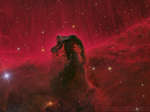 The Horsehead Nebula
17.12.2019
Sculpted by stellar winds and radiation, a magnificent interstellar dust cloud by chance has assumed this recognizable shape. Fittingly named the Horsehead Nebula, it is some 1,500 light-years distant, embedded in the vast Orion cloud complex.
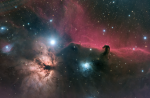 Horsehead and Flame
29.12.2022
The Horsehead Nebula, famous celestial dark marking also known as Barnard 33, is notched against a background glow of emission nebulae in this sharp cosmic skyscape. About five light-years "tall" the Horsehead lies some 1,500 light-years away in the constellation of Orion.
|
January February March April May June July August |
||||||||||||||||||||||||||||||||||||||||||||||||||||||||