
|
You entered: emission
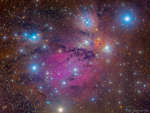 NGC 2170: Angel Nebula Still Life
25.08.2019
Is this a painting or a photograph? In this classic celestial still life composed with a cosmic brush, dusty nebula NGC 2170, also known as the Angel Nebula, shines near the image center. Reflecting...
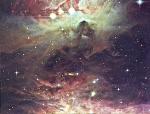 Reflections Of Orion
14.01.1999
The Orion Nebula and its surroundings present skygazers with a wondrous jumble of newborn stars, gas, and dust. Emission nebulae - glowing energized clouds of gas, and reflection nebulae - dust clouds shining by reflected starlight, abound at this photogenic cosmic location a mere 1,500 light-years or so away.
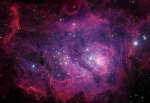 The Wide and Deep Lagoon
8.09.2016
Ridges of glowing interstellar gas and dark dust clouds inhabit the turbulent, cosmic depths of the Lagoon Nebula. Also known as M8, the bright star forming region is about 5,000 light-years distant.
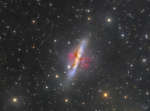 M82: Starburst Galaxy with a Superwind
8.07.2021
M82 is a starburst galaxy with a superwind. In fact, through ensuing supernova explosions and powerful winds from massive stars, the burst of star formation in M82 is driving a prodigious outflow. Evidence for the superwind from the galaxy's central regions is clear in sharp telescopic snapshot.
 APOD: 2023 December 13 Б Deep Field: The Heart Nebula
12.12.2023
What excites the Heart Nebula? First, the large emission nebula on the left, catalogued as IC 1805, looks somewhat like a human heart. The nebula glows brightly in red light emitted by its most prominent element, hydrogen, but this long-exposure image was also blended with light emitted by silicon (yellow) and oxygen (blue).
 Antares and Rho Ophiuchi
21.05.2000
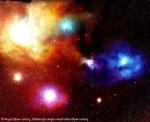
Why is the sky near Antares and Rho Ophiuchi so colorful? The colors result from a mixture of objects and processes. Fine dust illuminated from the front by starlight produces blue reflection nebulae. Gaseous clouds whose atoms are excited by ultraviolet starlight produce reddish emission nebulae. Backlit dust clouds block starlight and so appear dark.
 Massive Stars in NGC 6357
9.10.2008
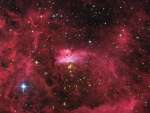
Massive Stars lie within NGC 6357, an expansive emission nebula complex some 8,000 light-years away in the tail of the constellation Scorpius. In fact, positioned just below center in this close-up view...
 NGC 1333 Stardust
18.04.2009
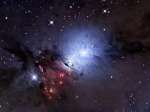
NGC 1333 is seen in visible light as a reflection nebula, dominated by bluish hues characteristic of starlight reflected by dust. A mere 1,000 light-years distant toward the heroic constellation Perseus, it lies at the edge of a large, star-forming molecular cloud.
 Colorful Clouds Near Rho Ophiuchi
5.07.2015
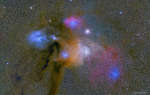
Why is the sky near Antares and Rho Ophiuchi so colorful? The colors result from a mixture of objects and processes. Fine dust illuminated from the front by starlight produces blue reflection nebulae. Gaseous clouds whose atoms are excited by ultraviolet starlight produce reddish emission nebulae. Backlit dust clouds block starlight and so appear dark.
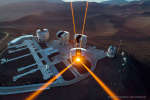 Attack of the Laser Guide Stars
17.05.2018
Dodging powerful laser beams, a drone captured this stunning aerial view. The confrontation took place above the 8.2 meter diameter Very Large Telescopes of the Paranal Observatory on planet Earth. Firing during a test...
|
January February March April May June July August |
||||||||||||||||||||||||||||||||||||||||||||||||||||||||