
|
You entered: emission
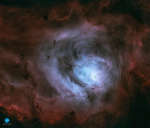 The Lagoon Nebula without Stars
8.08.2022
Ridges of glowing interstellar gas and dark dust clouds inhabit the turbulent, cosmic depths of the Lagoon Nebula. Also known as M8, the bright star forming region is about 5,000 light-years distant.
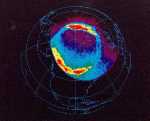 Aurora Crown the Earth
27.05.1996
What do aurora look like from space? The POLAR spacecraft answered this by photographing an auroral oval surrounding the north pole of the Earth, causing displays on both the night and day side. The auroral sub-storm, pictured in false-color above, developed within 15 minutes and may have lasted as long as on hour.
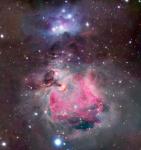 Colorful Clouds of Orion
20.12.2002
Revisiting one of the most famous nebulae in planet Earth's night sky, astrophotographer Robert Gendler has constructed this stunning, color-enhanced mosiac of the region surrounding the Great Nebula in Orion. As seen here...
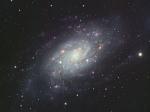 Spiral Galaxy NGC 2403 from Subaru
5.07.2006
Sprawling spiral arms dotted with bright red emission nebulas highlight this new and detailed image of nearby spiral galaxy NGC 2403. Also visible in the photogenic spiral galaxy are blue open clusters, dark dust lanes, and a bright but relatively small central nucleus.
 The Seagull Nebula
11.01.2014
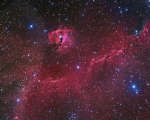
A broad expanse of glowing gas and dust presents a bird-like visage to astronomers from planet Earth, suggesting its popular moniker - The Seagull Nebula. This portrait of the cosmic bird covers a 1.6 degree wide swath across the plane of the Milky Way, near the direction of Sirius, alpha star of the constellation Canis Major.
 Nearby Spiral Galaxy NGC 4945
22.08.2019
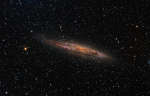
Large spiral galaxy NGC 4945 is seen edge-on near the center of this cosmic galaxy portrait. In fact, it's almost the size of our Milky Way Galaxy. NGC 4945's own dusty disk, young blue star clusters, and pink star forming regions standout in the sharp, colorful telescopic image.
 APOD: 2024 February 21 Б Seagull Nebula over Pinnacles Peak
21.02.2024
The bird is bigger than the peak. Nicknamed for its avian shape, the Seagull Nebula is an emission nebula on the night sky that is vast, spanning an angle over five times the diameter of the full moon and over 200 light years.
 The Kleinmann Low Nebula
2.03.1999
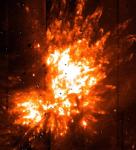
The most active part of the Orion Nebular Cloud Complex is an area known as the Kleinmann-Low Nebula. There, a cluster of young and forming stars is embedded in a molecular cloud filled with dust.
 Aurorae over Planet Earth
11.10.2012
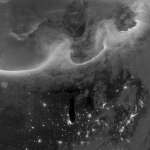
North America at night is easy to recognize in this view of our fair planet from orbit, acquired by the Suomi-NPP satellite on October 8. The spectacular waves of visible light emission rolling above the Canadian provinces of Quebec and Ontario in the upper half of the frame are the Aurora Borealis or northern lights.
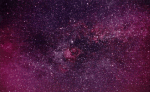 The Milky Way Near the Northern Cross
15.05.1996
This beautiful image of the sky near the bright star Deneb (just above center) reveals the stars, nebulae, and dark clouds along the plane of our Milky Way Galaxy as seen from the northern hemisphere (near Columbia Missouri, USA). Just below Deneb lies the suggestively shaped North American emission nebula.
|
January February March April May June July August |
||||||||||||||||||||||||||||||||||||||||||||||||||||||||