
|
You entered: emission
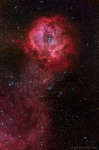 Long Stem Rosette Nebula
14.02.2021
Would the Rosette Nebula by any other name look as sweet? The bland New General Catalog designation of NGC 2237 doesn't appear to diminish the appearance of this flowery emission nebula, at the top of the image, atop a long stem of glowing hydrogen gas.
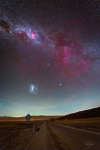 The Gum Nebula Supernova Remnant
29.11.2022
Because the Gum Nebula is the closest supernova remnant, it is actually hard to see. Spanning 40 degrees across the sky, the nebula appears so large and faint that it is easily lost in the din of a bright and complex background.
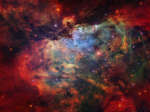 APOD: 2026 June 10 Б The Eagle Nebula and Friends
10.06.2026
What looks as if it is going to swallow the great Pillars of Creation? The Eagle Nebula (M16) is not a bird, a plane, or Superman. M16 is actually a combination of several celestial objects. NGC 6611 is the young star cluster that appears to peak out beneath the EagleБs БwingsБ.
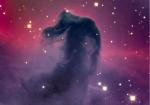 The Dark Horsehead Nebula
29.12.2000
While drifting through the cosmos, sculpted by stellar winds and radiation, this magnificent interstellar dust cloud has chanced to assume a recognizable shape. Fittingly named The Horsehead Nebula it is embedded in the immense complex of star forming gas and dust surrounding the Orion Nebula some 1,500 light-years distant.
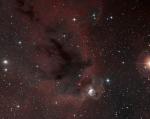 LDN 1622: Dark Nebula in Orion
11.05.2007
The silhouette of an intriguing dark nebula inhabits this cosmic scene, based on images from the Palomar Observatory Sky Survey. Lynds' Dark Nebula (LDN) 1622 appears against a faint background of glowing hydrogen gas only easily seen in long telescopic exposures of the region.
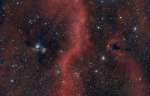 Decorating the Sky
25.12.2010
Bright stars, clouds of dust and glowing nebulae decorate this cosmic scene, a skyscape just north of Orion's belt. Close to the plane of our Milky Way Galaxy, the wide field view spans about 5.5 degrees. Striking bluish M78, a reflection nebula, is at the left.
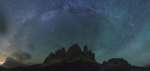 Airglow over Italy
6.09.2012
In this serene night skyscape, the Milky Way's graceful arc stretches over prominent peaks in the Italian Alps known as Tre Cime di Lavaredo. A 180 degree wide-angle panorama made in four exposures on August 24, the scene does look to the north and the sky is suffused with an eerie greenish light.
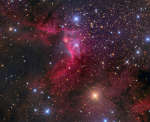 Sh2 155: The Cave Nebula
19.10.2013
This colorful skyscape features the dusty, reddish glow of Sharpless catalog emission region Sh2-155, the Cave Nebula. About 2,400 light-years away, the scene lies along the plane of our Milky Way Galaxy toward the royal northern constellation of Cepheus.
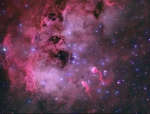 The Tadpoles of IC 410
13.11.2015
This telescopic close-up shows off the otherwise faint emission nebula IC 410. It also features two remarkable inhabitants of the cosmic pond of gas and dust below and right of center, the tadpoles of IC 410. Partly obscured by foreground dust, the nebula itself surrounds NGC 1893, a young galactic cluster of stars.
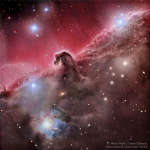 The Magnificent Horsehead Nebula
25.12.2016
Sculpted by stellar winds and radiation, a magnificent interstellar dust cloud by chance has assumed this recognizable shape. Fittingly named the Horsehead Nebula, it is some 1,500 light-years distant, embedded in the vast Orion cloud complex.
|
January February March April May June July August |
||||||||||||||||||||||||||||||||||||||||||||||||||||||||