
|
You entered: emission
 The Horsehead Nebula
10.12.2025
Sculpted by stellar winds and radiation, this dusty interstellar molecular cloud has by chance has assumed an immediately recognizable shape. Fittingly known as The Horsehead Nebula, it lies some 1,500 light-years distant, embedded in the vast Orion cloud complex.
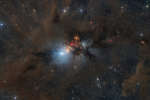 NGC 1333: Stellar Nursery in Perseus
30.01.2026
NGC 1333 is seen in visible light as a reflection nebula, dominated by bluish hues characteristic of starlight reflected by interstellar dust. A mere 1,000 light-years distant toward the heroic constellation Perseus, it lies at the edge of a large, star-forming molecular cloud.
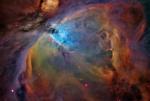 An Orion of a Different Color
25.03.2004
Look up into the sky tonight, and even with a good telescope you won't come across a sight quite like this one. It is a familiar object though, the grand stellar nursery known as the Orion Nebula.
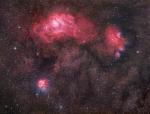 Sagittarius Triplet
9.09.2004
These three bright nebulae are often featured in telescopic tours of the constellation Sagittarius and the view toward the center of our Milky Way galaxy. In fact, 18th century cosmic tourist Charles Messier cataloged two of them; M8, the nebula above and left of center, and colorful M20 at the lower left.
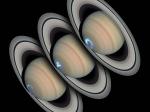 Persistent Saturnian Auroras
22.02.2005
Are Saturn's auroras like Earth's? To help answer this question, the Hubble Space Telescope and the Cassini spacecraft monitored Saturn's South Pole simultaneously as Cassini closed in on the gas giant in January 2004. Hubble snapped images in ultraviolet light, while Cassini recorded radio emissions and monitored the solar wind.
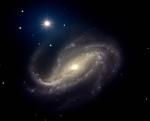 NGC 613: Spiral of Dust and Stars
1.10.2005
When morning twilight came to the Paranal Observatory in Chile, astronomers Mark Neeser and Peter Barthel interrupted their search for faint quasars, billions of light-years away. And just for a moment, they used Very Large Telescopes at the European Southern Observatory to appreciate the beauty of the nearby Universe.
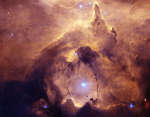 A Massive Star in NGC 6357
21.11.2010
For reasons unknown, NGC 6357 is forming some of the most massive stars ever discovered. One such massive star, near the center of NGC 6357, is framed above carving out its own interstellar castle with its energetic light from surrounding gas and dust.
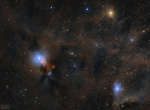 Stardust in the Perseus Molecular cloud
14.01.2017
Clouds of stardust drift through this deep skyscape. The cosmic scene spans nearly 2 degrees across the Perseus molecular cloud some 850 light-years away. A triangle of dusty nebulae reflecting light from embedded stars is captured in the telescopic field of view.
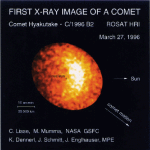 Unexpected X-rays from Comet Hyakutake
11.04.1996
The first X-rays ever detected from a comet were discovered from Comet Hyakutake with the ROSAT satellite on March 27th. The discovery is particularly surprising because there was little previous indication that comets emit any significant X-radiation.
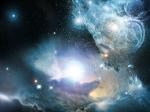 A Primodrial Quasar
20.05.2003
What did the first quasars look like? The nearest quasars are now known to be supermassive black holes in the centers of galaxies. Gas and dust that falls toward a quasar glows brightly, sometimes outglowing the entire home galaxy.
|
January February |
|||||||||||||||||||||||||||||||||||||||||||||||||