
|
You entered: emission
 APOD: 2024 November 18 Б Stars and Dust in the Pacman Nebula
18.11.2024
Stars can create huge and intricate dust sculptures from the dense and dark molecular clouds from which they are born. The tools the stars use to carve their detailed works are high energy light and fast stellar winds.
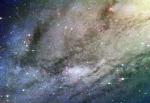 Southwest Andromeda
17.09.2001
This new image composite of the southwest region of M31 from the Subaru Telescope shows many stars, nebulae, and star clusters never before resolved. An older population of stars near Andromeda's center causes the yellow hue visible on the upper right. Young blue stars stand out in the spiral arms on the lower left.
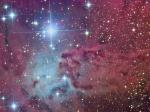 The Fox Fur Nebula
14.03.2005
The nebula surrounding bright star S Mon is filled with dark dust and glowing gas. The strange shapes originate from fine interstellar dust reacting in complex ways with the energetic light and hot gas being expelled by the young stars.
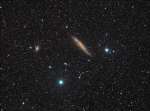 NGC 4945 in Centaurus
9.01.2009
Large, dusty, spiral galaxy NGC 4945 is seen edge-on near the center of this rich telescopic image. The field of view spans nearly 2 degrees, or about 4 times the width of the Full Moon, toward the expansive southern constellation Centaurus.
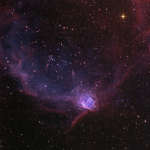 NGC 602 in the Flying Lizard Nebula
6.03.2015
Near the outskirts of the Small Magellanic Cloud, a satellite galaxy some 200 thousand light-years distant, lies 5 million year young star cluster NGC 602. Surrounded by natal gas and dust, NGC 602 is just below center in this telescopic field of view with the angular size of the Full Moon on the sky.
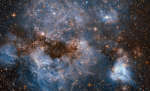 N159 in the Large Magellanic Cloud
28.01.2017
Over 150 light-years across, this cosmic maelstrom of gas and dust is not too far away. It lies south of the Tarantula Nebula in our satellite galaxy the Large Magellanic Cloud a mere 180,000 light-years distant. Massive stars have formed within.
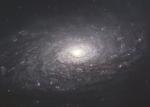 M63: The Sunflower Galaxy
27.06.2000
One of the bright spiral galaxies visible in the north sky is M63, the Sunflower Galaxy. M63, also catalogued as NGC 5055, can be found with a small telescope in the constellation of Canes Venaciti.
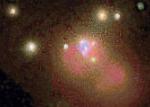 The Center of the Circinus Galaxy in X Rays
16.05.2001
Are black holes the cause of X-rays that pour out from the center of the Circinus galaxy? A new high-resolution image from the orbiting Chandra X-ray Observatory has resolved the inner regions of this nearby galaxy into several smaller sources. The image is shown above in representative-color.
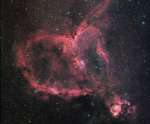 IC 1805: The Heart Nebula
14.02.2009
Sprawling across almost 200 light-years, emission nebula IC 1805 is a mix of glowing interstellar gas and dark dust clouds. Derived from its Valentine's-Day-approved shape, its nickname is the Heart Nebula. About 7,500 light-years away in the Perseus spiral arm of our galaxy, stars were born in IC 1805.
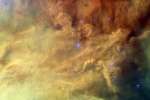 Hubble s Lagoon
2.10.2010
Like brush strokes on a canvas, ridges of color seem to flow across this scene. But here, the canvas is nearly 3 light-years wide and the colors map emission from ionized gas in the Lagoon Nebula, recorded by the Hubble Space Telescope's Advanced Camera for Surveys.
|
January February March April May June July August |
||||||||||||||||||||||||||||||||||||||||||||||||||||||||