
|
You entered: emission
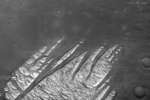 White Rock Fingers on Mars
15.02.2016
What caused this unusual light rock formation on Mars? Intrigued by the possibility that they could be salt deposits left over as an ancient lakebed dried-up, detailed studies of these fingers now indicate a more mundane possibility: volcanic ash. Studying the exact color of the formation indicated the possible volcanic origin.
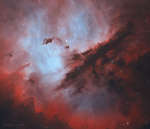 Dust Clouds of the Pacman Nebula
10.08.2022
Stars can create huge and intricate dust sculptures from the dense and dark molecular clouds from which they are born. The tools the stars use to carve their detailed works are high energy light and fast stellar winds.
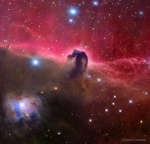 The Magnificent Horsehead Nebula
13.05.2015
Sculpted by stellar winds and radiation, a magnificent interstellar dust cloud by chance has assumed this recognizable shape. Fittingly named the Horsehead Nebula, it is some 1,500 light-years distant, embedded in the vast Orion cloud complex.
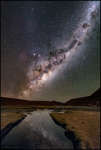 The Altiplano Night
7.07.2016
The Milky Way is massively bright on this cold, clear, altiplano night. At 4,500 meters its reflection in a river, a volcanic peak on the distant horizon, is captured in this stitched panorama under naturally dark skies of the northern Chilean highlands near San Pedro de Atacama.
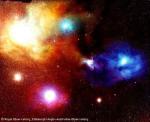 Antares and Rho Ophiuchi
9.05.2004
Why is the sky near Antares and Rho Ophiuchi so colorful? The colors result from a mixture of objects and processes. Fine dust illuminated from the front by starlight produces blue reflection nebulae. Gaseous clouds whose atoms are excited by ultraviolet starlight produce reddish emission nebulae. Backlit dust clouds block starlight and so appear dark.
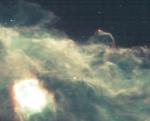 Infrared Horsehead
6.08.1998
This famous cosmic dust cloud was imaged in infrared light by the European Space Agency's Infrared Space Observatory (ISO) satellite. The false-color picture shows the bright infrared emission from dust and molecular gas in part of the Orion star forming region surrounding the Horsehead Nebula.
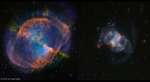 The Dumbells
17.12.2008
These two nebulae are cataloged as M27 (left) and M76, popularly known as The Dumbbell and the Little Dumbbell. Not intended to indicate substandard mental prowess, their popular names refer to their similar, dumbbell or hourglass shapes.
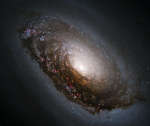 M64: The Sleeping Beauty Galaxy
12.06.2011
The Sleeping Beauty galaxy may appear peaceful at first sight but it is actually tossing and turning. In an unexpected twist, recent observations have shown that the gas in the outer regions of this photogenic spiral is rotating in the opposite direction from all of the stars!
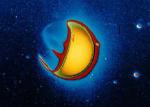 Ultraviolet Earth from the Moon
1.07.2000
Here's a switch: the above picture is of the Earth taken from a lunar observatory! This false color picture shows how the Earth glows in ultraviolet (UV) light. UV light is so blue humans can't see it.
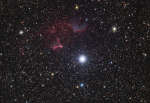 Gamma Cas and Friends
24.12.2009
Gamma Cassiopeiae shines high in northern autumn evening skies. The brightest spiky star in this rich and colorful Milky Way starfield, bluish Gamma Cas marks the central peak in the W-shaped constellation Cassiopeia.
|
January February March April May June July August |
||||||||||||||||||||||||||||||||||||||||||||||||||||||||