
|
You entered: Earth
 Polaris and the Trail of Comet ZTF
3.02.2023
Stars trace concentric arcs around the North Celestial Pole in this three hour long night sky composite, recorded with a digital camera fixed to a tripod on January 31, near цger, Lleida, Spain. On that date Comet C/2022 E3 (ZTF) was near its northernmost declination in planet Earth's sky.
 The Secret of the Black Aurora
1.01.2002
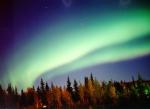
What causes black aurora? These gaps in normal bright aurora are frequently recorded but rarely questioned. Recent research using data from four Cluster spacecraft orbiting the Earth has now likely found the secret: black auroras are actually anti-auroras.
 Space Rock SQ222 Noticed After Pass
15.10.2003
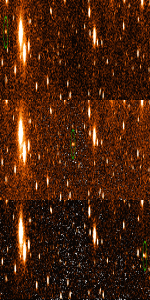
Why didn't we see it? An undetected asteroid zipped past the Earth undetected last month in the closest near miss yet recorded -- within a quarter of the distance to the Moon. Such...
 Meteors Over Quebec
16.08.2010
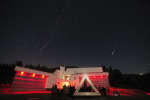
Meteors streaked through the sky above many of Earth's cities last week, but nobody was hurt, and no damage has been reported. The assault from space appeared to originate from someplace in the constellation of Perseus, and included millions of small projectiles hurtling toward Earth at over 200,000 kilometers per hour.
 Dragon Aurora over Norway
10.04.2018
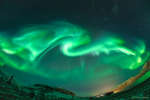
What's that in the sky? An aurora. A large coronal hole opened last month, a few days before this image was taken, throwing a cloud of fast moving electrons, protons, and ions toward the Earth.
 Eros At Sunset
24.08.2000
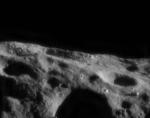
Gleaming in the rays of the setting sun, boulders litter the rugged surface of asteroid 433 Eros. The brightest boulder, at the edge of the large, shadowy crater near this picture's bottom center, is about 30 meters (100 feet) across.
 Sunrise Solstice at Stonehenge
21.06.2006
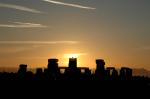
Today the Sun reaches its northernmost point in the planet Earth's sky. Called a solstice, the date traditionally marks a change of seasons -- from spring to summer in Earth's Northern Hemisphere and from fall to winter in Earth's Southern Hemisphere. Pictured above is the 2005 Summer Solstice celebration at Stonehenge in England.
 Two Million Stars on the Move
17.04.2017
If you could watch the night sky for one million years -- how would it change? Besides local effects caused by the Earth's spin and the reorientation of the Earth's spin axis, the stars themselves will move.
 JWST on the Road to L2
31.12.2021
This timelapse gif tracks the James Webb Space Telescope as it streaks across the stars of Orion on its journey to a destination beyond the Moon. Recorded on December 28, 12 consecutive exposures each 10 minutes long were aligned and combined with a subsequent color image of the background stars to create the animation.
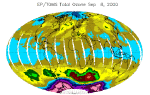 Antarctic Ozone Hole Widens
11.09.2000
It's back, and it's bigger than ever. The ozone hole that has been a cause of concern in recent years has again reformed over Earth's South Pole. The seasonal recurrence of the ozone hole was expected, although the size of the hole has never been so large this early in the season.
|
January February March April May June July August September October |
|||||||||||||||||||||||||||||||||||||||||||||||||