
|
You entered: Earth
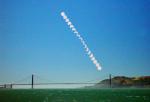 A Partial Eclipse Over the Golden Gate Bridge
12.06.2002
Part of the Sun disappeared behind the Moon earlier this week. Previously, the waning Moon was best visible from all places on Earth during the early morning hours because it trailed the Sun. As the Moon orbited the Earth, however, it caught up to the Sun and passed it on the sky.
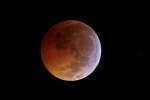 The Solstice Moon s Eclipse
23.12.2010
A big, bright, beautiful Full Moon slid into planet Earth's shadow early Tuesday morning. Remarkably, the total lunar eclipse coincided with the date of the December Solstice. During the eclipse, the best viewing...
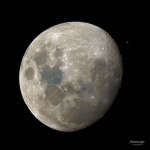 Saturn Behind the Moon
14.08.2019
What's that next to the Moon? Saturn. In its monthly trip around the Earth -- and hence Earth's sky -- our Moon passed nearly in front of Sun-orbiting Saturn earlier this week. Actually the Moon passed directly in front of Saturn from the viewpoints of a wide swath of Earth's Southern Hemisphere.
 APOD: 2025 February 12 Б Asteroid Bennu Holds the Building Blocks of Life
12.02.2025
What can a space rock tell us about life on Earth? NASA's OSIRIS-REx spacecraft made a careful approach to the near-Earth asteroid 101955 Bennu in October of 2020 to collect surface samples. In September 2023, the robotic spaceship returned these samples to Earth.
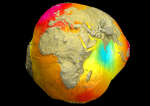 The Potsdam Gravity Potato
14.12.2014
Why do some places on Earth have higher gravity than others? Sometimes the reason is unknown. To help better understand the Earth's surface, sensitive measurments by the orbiting satellites GRACE and CHAMP were used to create a map of Earth's gravitational field.
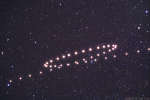 Retrograde Mars
13.06.2010
Why would Mars appear to move backwards? Most of the time, the apparent motion of Mars in Earth's sky is in one direction, slow but steady in front of the far distant stars. About every two years, however, the Earth passes Mars as they orbit around the Sun.
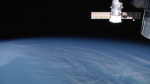 A Live View from the International Space Station
14.05.2014
If were floating above the Earth right now, this is what you might see. Two weeks ago, the robotic SpaceX Dragon capsule that delivered supplies to the Earth-orbiting International Space Station (ISS) also delivered High Definition Earth Viewing (HDEV) cameras that take and transmit live views of Earth.
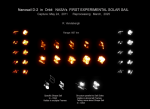 NanoSail D2
2.01.2026
In 2011, on January 20, NASA's NanoSail-D2 unfurled a very thin and very reflective 10 square meter sail becoming the first solar sail spacecraft in low Earth orbit. Often considered the stuff...
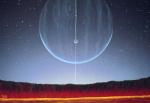 A Year of Assessing Astronomical Hazards
31.12.2002
Could an asteroid destroy civilization on Earth? Mountain-sized space rocks could potentially impact the Earth causing global effects, and perhaps even be mistaken for a nuclear blast of terrestrial origin. Such large impacts are rare but have happened before. Modern telescopes have therefore begun to scan the skies for signs of approaching celestial hazards.
 APOD: 2024 August 13 Б Giant Jet from the International Space Station
13.08.2024
What's that on the horizon? When circling the Earth on the International Space Station early last month, astronaut Matthew Dominick saw an unusual type of lightning just beyond the Earth's edge: a gigantic jet. The powerful jet appears on the left of the featured image in red and blue.
|
January February March April May June July August September October |
|||||||||||||||||||||||||||||||||||||||||||||||||