
|
You entered: Earth
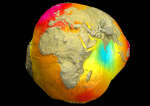 The Potsdam Gravity Potato
14.12.2014
Why do some places on Earth have higher gravity than others? Sometimes the reason is unknown. To help better understand the Earth's surface, sensitive measurments by the orbiting satellites GRACE and CHAMP were used to create a map of Earth's gravitational field.
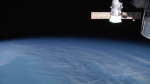 A Live View from the International Space Station
14.05.2014
If were floating above the Earth right now, this is what you might see. Two weeks ago, the robotic SpaceX Dragon capsule that delivered supplies to the Earth-orbiting International Space Station (ISS) also delivered High Definition Earth Viewing (HDEV) cameras that take and transmit live views of Earth.
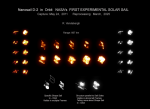 NanoSail D2
2.01.2026
In 2011, on January 20, NASA's NanoSail-D2 unfurled a very thin and very reflective 10 square meter sail becoming the first solar sail spacecraft in low Earth orbit. Often considered the stuff...
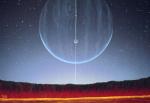 A Year of Assessing Astronomical Hazards
31.12.2002
Could an asteroid destroy civilization on Earth? Mountain-sized space rocks could potentially impact the Earth causing global effects, and perhaps even be mistaken for a nuclear blast of terrestrial origin. Such large impacts are rare but have happened before. Modern telescopes have therefore begun to scan the skies for signs of approaching celestial hazards.
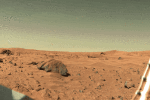 If You Could Stand on Mars
7.02.1996
If you could stand on Mars - what would you see? Viking 1 robot landers answered this question in 1976 with pictures like the one shown above. The dark rocks, red soil, and green-tinged sky grace this rendition of a normal Martian afternoon. At the bottom corners of the picture are portions of Viking spacecraft.
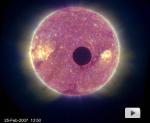 Lunar Transit from STEREO
3.03.2007
A million miles from planet Earth, last weekend the STEREO B spacecraft found itself in the shadow of the Moon. So, looking toward the Sun, extreme ultraviolet cameras onboard STEREO B were able to record a stunning movie of a lunar transit (aka solar eclipse), as the Moon tracked across the solar disk.
 Crescents of Venus
26.08.2023
Just as the Moon goes through phases, Venus' visible sunlit hemisphere waxes and wanes. This sequence of telescopic images illustrates the steady changes for Venus during its recent 2023 apparition as our evening star. Gliding along its interior orbit between Earth and Sun, Venus grows larger during that period because it is approaching planet Earth.
 Galaxies in Space
8.03.2025
The plane of our Milky Way galaxy extends beyond the limb of planet Earth in this space age exposure captured by astronaut Don Pettit. His camera, with low light and long duration settings, was pointed out the window of a Dragon crew spacecraft docked with the International Space Station on January 29.
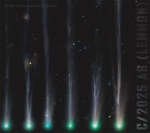 APOD: 2025 October 6 Б The Changing Ion Tail of Comet Lemmon
6.10.2025
How does a comet tail change? It depends on the comet. The ion tail of Comet C/2025 A6 (Lemmon) has been changing markedly, as detailed in the featured image sequenced over six days between September 25 and October 4 (left to right) from Texas, USA.
 APOD: 2024 June 2 Б Rotating Moon from LRO
2.06.2024
No one, presently, sees the Moon rotate like this. That's because the Earth's moon is tidally locked to the Earth, showing us only one side. Given modern digital technology, however, combined with many detailed images returned by the Lunar Reconnaissance Orbiter (LRO), a high resolution virtual Moon rotation movie has been composed.
|
January February March April May June July August September October |
|||||||||||||||||||||||||||||||||||||||||||||||||