
|
You entered: Earth
 APOD: 2024 April 23 Б Contrail Shadow X
23.04.2024
What created this giant X in the clouds? It was the shadow of contrails illuminated from below. When airplanes fly, humid engine exhaust may form water droplets that might freeze in Earth's cold upper atmosphere. These persistent streams of water and ice scatter light from the Sun above and so appear bright from below.
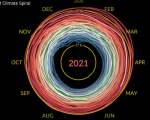 Earths Recent Climate Spiral
22.08.2022
Is our Earth warming? Compared to the past 250 million years, the Earth is currently enduring a relative cold spell, possibly about four degrees Celsius below average. Over the past 120 years, though, data indicate that the average global temperature of the Earth has increased by nearly one degree Celsius.
APOD: 2026 April 22 Б Earthset with an iPhone
22.04.2026
What does it mean for the Earth to set? Artemis II Commander Reid Wiseman gave us another spectacular view of Earth from their historic flyby of the Moon. Commander Wiseman's video, taken with an iPhone at 8x zoom, shows our entire planet gradually blocked from view by the Moon.
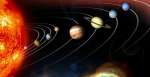 To Scale: The Solar System
25.12.2015
Want to build a scale model Solar System? A blue marble 1.4 centimeters (about half an inch) across would be a good choice for a scale model Earth. Since the Sun is 109 times the diameter of Earth, a 1.5 meter diameter balloon could represent the Sun.
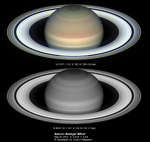 Saturn at Opposition
29.05.2015
Telescopic observers on Earth have been treated to spectacular views of Saturn lately as the ringed planet reached its 2015 opposition on May 23 at 0200 UT. Of course opposition means opposite the Sun in Earth's sky. So near opposition Saturn is up all night, at its closest and brightest for the year.
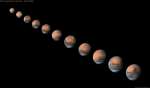 Mars Approach
1.06.2018
Since the distance from Earth to Mars changes drastically as the planets orbit the Sun, Mars' appearance changes dramaticaly. Mars is bright now, and it's getting closer and brighter still as it orbits toward its 2018 opposition and closest approach to Earth in late July.
 The Most Distant Sun
9.07.2007
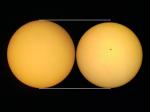
When is the Sun most distant from Earth? It happened again just this past weekend. A common misconception is that the Sun is most distant during the winter, when it's the coldest. In truth, however, the seasonal temperatures are more greatly influenced by the number of daylight hours and how high the Sun rises.
 Mars in the Loop
8.11.2018
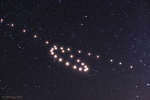
This composite of images spaced some 5 to 9 days apart, from late April (bottom right) through November 5 (top left), traces the retrograde motion of ruddy-colored Mars through planet Earth's night sky.
 Neptune in Infrared
25.10.1999
Neptune has never looked so clear in infrared light. Neptune is the eighth most distant planet from the Sun, thirty times the Earth-Sun distance. Neptune is the fourth largest planet, almost four times Earth's diameter. Surprisingly, Neptune radiates about twice as much energy as it receives from the Sun.
 Eagle Aurora over Norway
14.07.2019
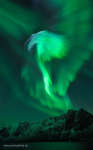
What's that in the sky? An aurora. A large coronal mass ejection occurred on our Sun five days before this 2012 image was taken, throwing a cloud of fast moving electrons, protons, and ions toward the Earth.
|
January February March April May June July August September October |
|||||||||||||||||||||||||||||||||||||||||||||||||