
|
You entered: Earth
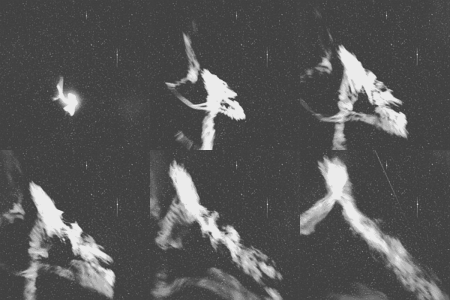 A Leonid Meteor Explodes
18.11.2001
Last night and tonight, a lucky few may see a meteor explode. As our Earth passes unusually close to debris expelled from Comet Tempel-Tuttle, many sand-sized particles from this comet are entering and burning up in the Earth's atmosphere.
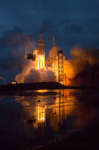 Orion Launch
5.12.2014
Headed for two orbits of planet Earth and a splashdown in the Pacific, Orion blazed into the early morning sky on Friday at 7:05am ET. The spacecraft was launched atop a United Launch Aliance Delta IV Heavy rocket from Cape Canaveral Air Force Station in Florida.
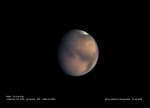 The Red Planet Mars
30.07.2020
Mars looks pretty sharp in this backyard telescope image captured on July 23 from Hoegaarden, Belgium, planet Earth. The Red Planet's bright south polar cap is bathed in sunlight at the top of the inverted view, while the dark feature known as Syrtis Major extends toward the right (eastern) edge.
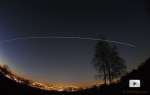 ISS: Sunlight to Shadow
28.02.2008
Orbiting 400,000 kilometers above the Earth, the Moon slid into Earth's shadow to begin last week's total lunar eclipse. Of course the International Space Station (ISS) slides into Earth's shadow every 90 minutes, the time it takes it to complete one orbit at an altitude of about 400 kilometers.
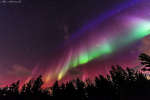 A Flag Shaped Aurora over Sweden
14.03.2021
It appeared, momentarily, like a 50-km tall banded flag. In mid-March of 2015, an energetic Coronal Mass Ejection directed toward a clear magnetic channel to Earth led to one of the more intense geomagnetic storms of recent years. A visual result was wide spread auroras being seen over many countries near Earth's magnetic poles.
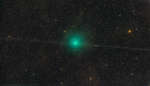 APOD: 2026 July 17 Б The Dust Trail of Comet Tempel 2
17.07.2026
Comet 10P/Tempel 2 orbits the Sun once every 5.4 years. Currently visible in binoculars or small telescopes toward the constellation Capricornus, the periodic comet is captured in this sharp telescopic image from July 11 sporting a bright nuclear region and pretty greenish coma.
 APOD: 2023 May 23 Б Jupiters Swirls from Juno
23.05.2023
Big storms are different on Jupiter. On Earth, huge hurricanes and colossal cyclones are centered on regions of low pressure, but on Jupiter, it is the high-pressure, anti-cyclone storms that are the largest. On Earth, large storms can last weeks, but on Jupiter they can last years.
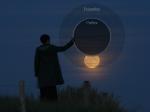 Shadow Play
9.09.2006
During September 7th's lunar eclipse, the Moon slid through the Earth's shadow. Extending into space, Earth's cone-shaped shadow has two distinct parts, the lighter, outer part or penumbra, and the darker, inner shadow called the umbra. For this eclipse, the lunar disk just grazed the shadow's dark inner umbra.
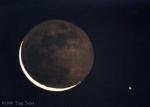 Mercury And The Moon
11.11.1999
Mercury is the closest planet to the Sun and never moves far from our parent star in Earth's sky. Racing around its tight orbit, this well-done world is a little over 1/3 the diameter of Earth and is often lost to our view in the solar glare.
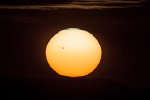 Sunspot at Sunset
8.01.2014
Sunsets may be the most watched celestial event, but lately sunsets have even offered something extra. A sunspot so large it was visible to the naked eye is captured in Swiss skies in this...
|
January February March April May June July August September October |
|||||||||||||||||||||||||||||||||||||||||||||||||