
|
You entered: Earth
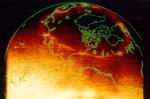 A Complete Aurora
2.04.1997
Aurora frequently make complete rings around a pole of the Earth. This particular "crown", visible in orange near the top of this image, was taken by the orbiting Polar spacecraft about one year ago and released by NASA last month.
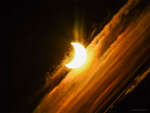 Partial Solar Eclipse over Argentina
2.05.2022
What's happened to the Sun? Two days ago, parts of South America were treated to a partial solar eclipse -- where the Moon blocked out part of the Sun. The featured image shows an image of the partially eclipsed Sun through clouds as it was setting over Patagonia, Argentina.
 A Conjunction of Crescents
8.02.2025
A waxing crescent Moon and a waning crescent Venus are found at opposite corners of this twilight telephoto field of view. The close conjunction of the two brightest celestial beacons in planet Earth's western evening sky was captured on February 1 from Rosario, Argentina.
 APOD: 2024 October 13 Б Aurora Timelapse Over Italian Alps
13.10.2024
Did you see last night's aurora? This question was relevant around much of the world a few days ago because a powerful auroral storm became visible unusually far from the Earth's poles.
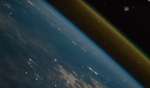 Rocket Launch as Seen from the Space Station
1.04.2021
Have you ever seen a rocket launch -- from space? A close inspection of the featured time-lapse video will reveal a rocket rising to Earth orbit as seen from the International Space Station (ISS).
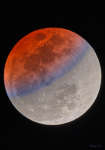 A Blue Banded Blood Moon
1.12.2021
What causes a blue band to cross the Moon during a lunar eclipse? The blue band is real but usually quite hard to see. The featured HDR image of last week's lunar eclipse, however -- taken from Yancheng, China -- has been digitally processed to equalize the Moon's brightness and exaggerate the colors.
 APOD: 2025 September 20 Б Gibbous vs Crescent
20.09.2025
Early risers around planet Earth have enjoyed a shining crescent Moon near brilliant Venus, close to the eastern horizon in recent morning twilight skies. And yesterday, on September 19, skygazers watching from some locations...
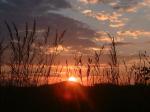 Zimbabwe Sunset
21.06.2002
Today's scheduled geocentric astronomical event is the Solstice, with the Sun reaching its northernmost declination at 13 hours 24 minutes Universal Time. For denizens of planet Earth this Solstice marks the begining of Summer in the northern hemisphere and Winter in the south.
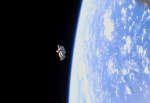 SuitSat1: A Spacesuit Floats Free
27.04.2014
A spacesuit floated away from the International Space Station eight years ago, but no investigation was conducted. Everyone knew that it pushed by the space station crew. Dubbed Suitsat-1, the unneeded Russian Orlan spacesuit filled mostly with old clothes was fitted with a faint radio transmitter and released to orbit the Earth.
 Neptune at Night
9.11.2024
Ice giant Neptune is faint in Earth's night sky. Some 30 times farther from the Sun than our fair planet, telescopes are needed to catch a glimpse of the dim and distant world. This dramatic view of Neptune's night just isn't possible for telescopes in the vicinity of planet Earth though.
|
January February March April May June July August September October |
|||||||||||||||||||||||||||||||||||||||||||||||||