
|
You entered: ice
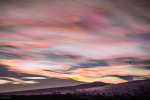 Nacreous Clouds over Sweden
9.01.2020
Vivid and lustrous, wafting iridescent waves of color filled this mountain and skyscape near Tanndalen, Sweden on January 3. Known as nacreous clouds or mother-of-pearl clouds, they are rare. This northern winter season they have been making unforgettable appearances at high latitudes, though.
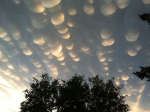 Mammatus Clouds Over Saskatchewan
23.10.2012
Normal cloud bottoms are flat. This is because moist warm air that rises and cools will condense into water droplets at a specific temperature, which usually corresponds to a very specific height. As water droplets grow, an opaque cloud forms.
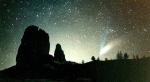 Hale-Bopp Above the Cinqui Torri Mountains
10.06.1997
Hale-Bopp may be the most photographed comet in history. Above, our photogenic giant flying snowball appeared last month as a backdrop to the "Cinque Torri" Mountains near Contina d'Ampezzo, Italy. Although the comet...
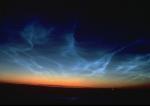 Noctilucent Clouds
26.07.1999
Sometimes it's night on the ground but day in the air. As the Earth rotates to eclipse the Sun, sunset rises up from the ground. Therefore, at sunset on the ground, sunlight still shines on clouds above.
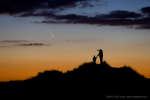 Comet PANSTARRS Just After Sunset
18.03.2013
Have you seen the comet? As Comet PANSTARRS fades, careful observers -- even with unaided eyes -- should still be able to find the shedding ice ball on the western horizon just after sunset. Pictured above, Comet PANSTARRS (C/2011 L4) was pointed out from a hilltop last week on First Encounter Beach in Massachusetts, USA.
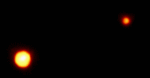 Pluto: The Frozen Planet
27.12.1997
The Hubble Space Telescope imaged Pluto and its moon Charon in 1994. Pluto is usually the most distant planet from the Sun but because of its elliptic orbit Pluto crossed inside of Neptune's orbit in 1979 and will cross back out again in 1999.
 Polar Polygons on Mars
14.07.2004
What's the best way to the city center? What looks like a street map of some city on Earth is actually a series of naturally-formed fragmented polar polygons on Mars. The existence...
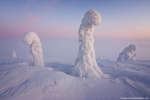 Sentinels of the Arctic
11.04.2015
Who guards the north? Judging from the above photograph, possibly giant trees covered in snow and ice. The featured picture was taken a few winters ago in Finnish Lapland where weather can include sub-freezing temperatures and driving snow.
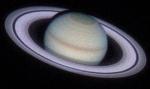 Saturn in Color
11.03.1997
Saturn is unusual but photogenic. The second largest planet in our Solar System, behind Jupiter, has been easily identifiable at night since history has been recorded. It was only with the invention of the telescope, however, that any evidence of its majestic ring system became apparent.
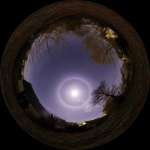 Circle Around the Moon
12.02.2009
If your sister-in-law phoned you at 1am to tell you there was a circle around the Moon, how would you react? When it happened to him early last Sunday morning, photographer Laurent Laveder, grabbed his equipment and ran outside!
|
January February March April May |
|||||||||||||||||||||||||||||||||||||||||||||||||