
|
You entered: ice
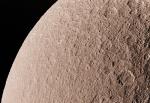 Rhea: Saturn's Second Largest Moon
8.06.2003
Rhea is the second largest moon of Saturn, behind Titan, and the largest without an atmosphere. It is composed mostly of water ice, but has a small rocky core. Rhea's rotation and orbit are locked together (just like Earth's Moon) so that one side always faces Saturn.
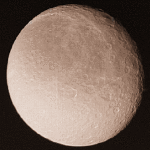 Rhea: Saturn's Second Largest Moon
14.10.1995
Rhea is the second largest moon of Saturn, behind Titan, and the largest without an atmosphere. It is composed mostly of water ice, but has a small rocky core. Rhea's rotation and orbit are locked together (just like Earth's Moon) so that one side always faces Saturn.
 Sentinels of the Arctic
29.05.2012
Who guards the north? Judging from the above photograph, possibly giant trees covered in snow and ice. The picture was taken last winter in Finnish Lapland where weather can include sub-freezing temperatures and driving snow. Surreal landscapes sometimes result, where common trees become cloaked in white and so appear, to some, as watchful aliens.
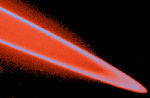 Jupiter's Rings
2.08.1995
Astronomers using NASA's Voyager spacecraft to search for a ring system around Jupiter discovered these faint rings in 1979. Unlike Saturn's bright rings which are composed of chunks of rock and ice, Jupiter's rings appear to consist of fine particles of dust.
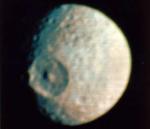 Mimas: Small Moon with a Big Crater
25.04.1999
Mimas is one of the smaller moons of Saturn but shows one of the largest impact craters. In fact, if the impact had been much greater, it would have disrupted the entire satellite. The large crater has been named Herschel after the 1789 discoverer of Mimas, Sir William Herschel.
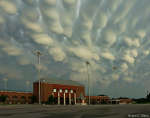 Mammatus Clouds over Nebraska
15.12.2019
When do cloud bottoms appear like bubbles? Normally, cloud bottoms are flat. This is because moist warm air that rises and cools will condense into water droplets at a specific temperature, which usually corresponds to a very specific height. As water droplets grow, an opaque cloud forms.
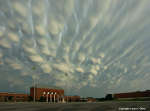 Mammatus Clouds over Nebraska
15.04.2014
When do cloud bottoms appear like bubbles? Normally, cloud bottoms are flat. This is because moist warm air that rises and cools will condense into water droplets at a specific temperature, which usually corresponds to a very specific height. As water droplets grow, an opaque cloud forms.
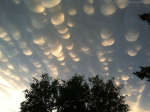 Mammatus Clouds Over Saskatchewan
18.10.2015
Why is this cloud so bubbly? Normally, cloud bottoms are flat. The flatness is caused by moist warm air that rises and cools and so condenses into water droplets at a specific temperature, which usually corresponds to a very specific height. As water droplets grow, an opaque cloud forms.
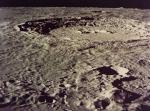 Crater Copernicus
13.05.2001
One of the more prominent craters on the Moon is named Copernicus. Copernicus is a large young crater visible with binoculars slightly northwest of the center of the Moon's Earth-facing hemisphere. Copernicus is distinguished by its size and by the many bright rays pointing out from it.
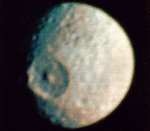 Mimas: Small Moon with A Big Crater
24.09.1995
Mimas is one of the smaller moons of Saturn but shows one of the largest impact craters! In fact, if the impact had been much greater, it would have disrupted the entire satellite. The large crater has been named Herschel after the 1789 discoverer of Mimas, Sir William Herschel.
|
January February March April May |
|||||||||||||||||||||||||||||||||||||||||||||||||