
|
You entered: ice
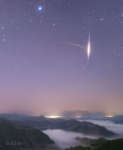 APOD: 2026 January 12 Б Meteor Dust
12.01.2026
What's happening to this meteor? It is shedding its outer layers as it passes through the Earth's atmosphere and heats up. The sudden high temperatures not only cause the bright glow along the dramatic streak but also melt and vaporize the meteor's component rock and ice, creating dust.
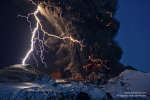 Ash and Lightning Above an Icelandic Volcano
30.07.2012
Why did the picturesque 2010 volcanic eruption in Iceland create so much ash? Although the large ash plume was not unparalleled in its abundance, its location was particularly noticeable because it drifted across such well-populated areas.
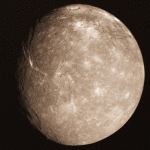 Uranus' Largest Moon: Titania
4.03.1996
Titania's tortured terrain is a mix of valleys and craters. NASA's interplanetary robot spacecraft Voyager 2 passed this moon of Uranus in 1986 and took the above photograph. The photograph was then transmitted back to earth by radio.
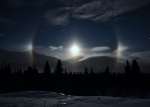 Alaskan Moondogs
26.01.2013
Moonlight illuminates a snowy scene in this night land and skyscape made on January 17 from Lower Miller Creek, Alaska, USA. Overexposed near the mountainous western horizon is the first quarter Moon itself, surrounded by an icy halo and flanked left and right by moondogs.
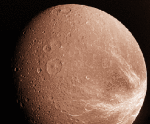 Saturn's Moon Dione
9.10.1995
Dione, one of Saturn's larger moons, is remarkable for its bright surface streaks. These streaks run across some of Dione's many craters, which indicate that the process which created the streaks occurred later than the process which created the craters.
 Good Morning Mars
19.06.1998
Looking down on the Northern Hemisphere of Mars on June 1, the Mars Global Surveyor spacecraft's wide angle camera recorded this morning image of the red planet. Mars Global Surveyor's orbit...
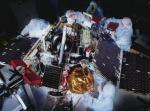 Invader From Earth
8.01.1999
These technicians are working on the solar-paneled Mars Polar Lander - yet another robotic spacecraft scheduled to invade the red planet. Mars Polar Lander is part of a series of missions focusing on a search for evidence of past or present life.
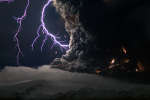 Ash and Lightning Above an Icelandic Volcano
19.04.2010
Why did the recent volcanic eruption in Iceland create so much ash? Although the large ash plume was not unparalleled in its abundance, its location was particularly noticeable because it drifted across such well populated areas.
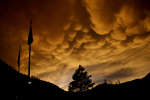 Mammatus Clouds Over Olympic Valley
20.02.2011
What's happened to these clouds? Normal cloud bottoms are flat because moist warm air that rises and cools will condense into water droplets at a very specific temperature, which usually corresponds to a very specific height. After water droplets form that air becomes an opaque cloud.
 Ash and Lightning above an Icelandic Volcano
20.04.2014
Why did a picturesque 2010 volcanic eruption in Iceland create so much ash? Although the large ash plume was not unparalleled in its abundance, its location was particularly noticeable because it drifted across such well-populated areas.
|
January February March April May |
|||||||||||||||||||||||||||||||||||||||||||||||||