
|
You entered: ice
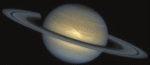 A Storm on Saturn
18.10.1995
The white wisp shown on Saturn's cloud tops is actually a major storm system only discovered in December of 1994. Saturn's clouds are composed of primarily hydrogen and helium, but the storm's white clouds are actually ammonia ice crystals that have frozen upon upheaval to the top of the atmosphere.
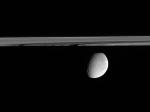 Slightly Beneath Saturns Ring Plane
5.04.2006
When orbiting Saturn, be sure to watch for breathtaking superpositions of moons, rings, and shadows. One such picturesque vista was visible recently to the robot Cassini spacecraft now orbiting Saturn. In late February, Cassini captured a Rhea, the second largest moon of Saturn, while looking up from slightly beneath Saturn's expansive ring plane.
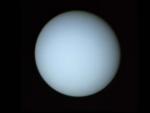 Uranus: The Tilted Planet
26.08.2001
Uranus is the third largest planet in our Solar System after Jupiter and Saturn. Uranus is composed mostly of rock and ices, but with a thick hydrogen and helium atmosphere. The blue hue of Uranus' atmosphere arises from the small amount of methane which preferentially absorbs red light.
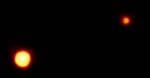 Pluto: The Frozen Planet
13.02.1999
This portrait of Pluto and its companion Charon was taken by the Hubble Space Telescope in 1994. Pluto is usually the most distant planet from the Sun but because of its eccentric orbit Pluto crossed inside of Neptune's orbit in 1979.
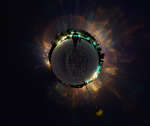 Light Pillars from a Little Planet
31.01.2014
Eerie pillars of light ring the edges of this snowy little planet. Of course the little planet is planet Earth, shown in a nadir-to-zenith, around-the-horizon, little planet projection. The spherical panoramic image mosaic maps a view from Siilinjärvi in eastern Finland.
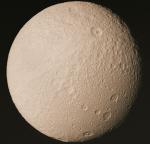 Saturns Moon Tethys
19.05.2002
Tethys is one of the larger and closer moons of Saturn. It was visited by both Voyager spacecraft - Voyager 1 in November 1980 and by Voyager 2 in August 1981. Tethys is now known to be composed almost completely of water ice. Tethys shows a large impact crater that nearly circles the planet.
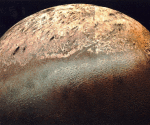 Triton: Neptune's Largest Moon
23.11.1997
On October 10th, 1846, William Lassell was observing the newly discovered planet Neptune. He was attempting to confirm his observation, made just the previous week, that Neptune had a ring. But this time he discovered that Neptune had a satellite as well.
 Jyvцskylц in the Sky
25.01.2024
You might not immediately recognize this street map of a neighborhood in Jyvцskylц, Finland, planet Earth. But that's probably because the map was projected into the night sky and captured with an allsky camera on January 16. The temperature recorded on that northern winter night was around minus 20 degrees Celsius.
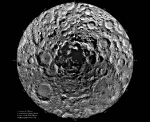 Shadow at the Lunar South Pole
28.11.1995
In 1994, the space probe Clementine spent 70 days in lunar orbit mapping the Moon's surface. Shown above is a dramatically detailed composite view centered on the Moon's South Pole constructed from 1500 Clementine images.
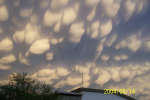 Mammatus Clouds Over Mexico
30.12.2007
Normal cloud bottoms are flat because moist warm air that rises and cools will condense into water droplets at a very specific temperature, which usually corresponds to a very specific height. After water droplets form that air becomes an opaque cloud.
|
January February March April May |
|||||||||||||||||||||||||||||||||||||||||||||||||