
|
You entered: ice
 Northern Pluto
18.08.2023
Gaze across the frozen canyons of northern Pluto in this contrast enhanced color scene. The image data used to construct it was acquired in July 2015 by the New Horizons spacecraft as it made the first reconnaissance flight through the remote Pluto system six billion kilometers from the Sun.
 Asteroid 2012 DA14 Passes the Earth
17.02.2013
There it goes. That small spot moving in front of background stars in the above video is a potentially dangerous asteroid passing above the Earth's atmosphere. This past Friday, the 50-meter wide asteroid...
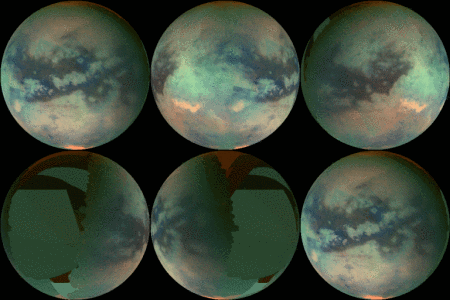 Rotating Titan in Infrared Light
15.02.2006
Titan is one of the strangest places in our Solar System. The only moon known with thick clouds, this unusual satellite of Saturn shows evidence of evaporating lakes created by methane rain. The clouds...
 APOD: 2025 October 19 Б Comet Churyumov Gerasimenko Creates Its Tails
19.10.2025
Where do comet tails come from? There are usually no obvious places on the nuclei of comets from which the jets that create comet tails emanate. One of the best images of emerging jets...
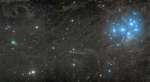 Two Comets and a Star Cluster
2.10.2017
Two unusual spots are on the move near the famous Pleiades star cluster. Shifting only a small amount per night, these spots are actually comets in our nearby Solar System that by chance wandered into the field of the light-years distant stars.
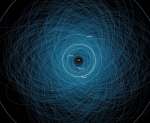 Orbits of Potentially Hazardous Asteroids
12.08.2013
Are asteroids dangerous? Some are, but the likelihood of a dangerous asteroid striking the Earth during any given year is low. Because some past mass extinction events have been linked to asteroid impacts, however, humanity has made it a priority to find and catalog those asteroids that may one day affect life on Earth.
APOD: 2026 July 29 Б Psyche Receives Gravity Assist from Mars
29.07.2026
Solar System bodies make deep space exploration more fuel efficient! TodayБs video shows the Psyche spacecraft gaining speed and changing its trajectory with minimal fuel spent due to a gravity assist from Mars in May 2026. Mars has an average orbital speed of almost 87,000 km/h (54,000 mph) around the Sun.
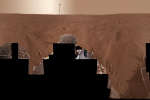 A Mars Panorama from the Phoenix Lander
12.08.2008
If you could stand on Mars, what would you see? The robotic Phoenix spacecraft that just landed on Mars in May recorded the above spectacular panorama. The above image is actually a digital combination of over 100 camera pointings and surveys fully 360 degrees around the busy robotic laboratory.
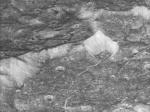 4500 Kilometers Above Dione
26.10.2005
What does the surface of Saturn's moon Dione look like? To find out, the robot Cassini spacecraft currently orbiting Saturn flew right past the fourth largest moon of the giant planet earlier this month. Pictured above is an image taken about 4,500 kilometers above Dione's icy surface, spanning about 23 kilometers.
 APOD: 2026 August 5 Б Spokes on Saturn's B Ring
5.08.2026
DonБt get spooked by SaturnБs ghostly spokes! Today we feature a nearly two-hour timelapse of Saturn and its rings looping forwards and backwards. A day on Saturn is only 10 hours long, so two hours of observation covers quite a bit of its rotation.
|
January February March April May June July August |
||||||||||||||||||||||||||||||||||||||||||||||||||||||||