
|
You entered: image
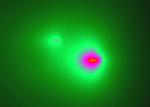 Another Comet LINEAR Breaks Up
21.05.2001
Last year, a different comet LINEAR (C/1999 S4) broke up. This year, a comet first imaged by the Lincoln Near Asteroid Research (LINEAR) telescope in New Mexico on 2001 January 3, is also breaking up.
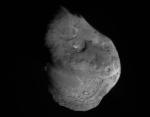 The Nucleus of Comet Tempel 1
15.09.2005
Approaching the nucleus of comet Tempel 1 at ten kilometers per second, the Deep Impact probe's targeting camera recorded a truly dramatic series of images. Successive pictures improve in resolution and have been...
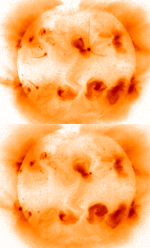 X Ray Triple Jet
31.07.1999
Recorded on July 7, 1998, this animation using X-ray images of the Sun shows an amazing event - three nearly simultaneous jets connected with solar active regions. The two frames were taken several hours apart by the Soft X-ray Telescope on board the orbiting Yohkoh observatory.
 Planetary Nebula NGC 2440
15.02.2007
Planetary nebula NGC 2440 has an intriguing bow-tie shape in this stunning view from space. The nebula is composed of material cast off by a dying sun-like star as it enters its white dwarf phase of evolution.
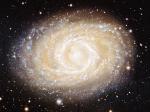 Barred Spiral Galaxy M95
14.03.2007
Why do some spiral galaxies have a ring around the center? First and foremost, M95 is one of the closer examples of a big and beautiful barred spiral galaxy. Visible in the above recent...
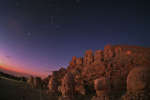 Orion Dawn Over Mount Nemrut
16.12.2008
What's that in front of Orion? Forty kilometers north of Kahta, Turkey, lies Mount Nemrut, a mountain adorned with the fragments of vast statues built over 2000 years ago. The stone sculptures once...
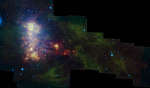 The Tail of the Small Magellanic Cloud
7.01.2010
A satellite galaxy of our Milky Way, the Small Magellanic Cloud is wonder of the southern sky, named for 16th century Portuguese circumnavigator Ferdinand Magellan. Some 200,000 light-years distant in the constellation Tucana...
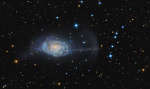 NGC 4651: The Umbrella Galaxy
15.04.2010
Spiral galaxy NGC 4651 is a mere 35 million light-years distant, toward the well-groomed constellation Coma Berenices. About 50 thousand light-years across, this galaxy is seen to have a faint umbrella-shaped structure (right) that seems to extend some 50 thousand light-years farther, beyond the bright galactic disk.
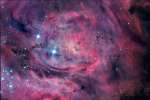 M8: The Lagoon Nebula
5.08.2010
This beautiful cosmic cloud is a popular stop on telescopic tours of the constellation Sagittarius. Eighteenth century cosmic tourist Charles Messier cataloged the bright nebula as M8. Modern day astronomers recognize the Lagoon Nebula as an active stellar nursery about 5,000 light-years distant, in the direction of the center of our Milky Way Galaxy.
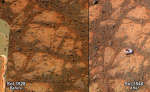 Jelly Donut Shaped Rock Appears on Mars
29.01.2014
What if a rock that looked like a jelly donut suddenly appeared on Mars? That's just what happened in front of the robotic Opportunity rover currently exploring the red planet. The unexpectedly placed...
|
January February March April May June July August September |
|||||||||||||||||||||||||||||||||||||||||||||||||