
|
You entered: image
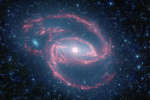 NGC 1097: Spiral Galaxy with a Central Eye
27.07.2009
What's happening at the center of spiral galaxy NGC 1097? No one is sure, but it likely involves a supermassive black hole. Matter falling in from a bar of stars and gas across the center is likely being heated by an extremely energetic region surrounding the central black hole.
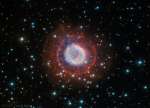 Planetary Nebula NGC 2438
7.04.2011
NGC 2438 is a planetary nebula, the gaseous shroud cast off by a dying sunlike star billions of years old whose central reservoir of hydrogen fuel has been exhausted. About 3,000 light-years distant it lies within the boundaries of the nautical constellation Puppis.
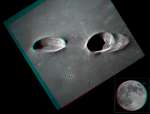 Messier Craters in Stereo
8.06.2013
Many bright nebulae and star clusters in planet Earth's sky are associated with the name of astronomer Charles Messier, from his famous 18th century catalog. His name is also given to these two large and remarkable craters on the Moon.
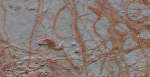 The Surface of Europa
19.05.2016
An enhanced-color view, this image covers a 350 by 750 kilometer swath across the surface of Jupiter's tantalizing moon Europa. The close-up combines high-resolution image data with lower resolution color data from observations made in 1998 by the Galileo spacecraft.
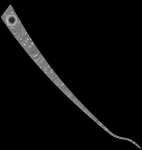 Noodle Mosaic of Saturn
28.07.2017
On April 26 the Cassini spacecraft swooped toward Saturn on the first of its Grand Finale dives between Saturn and rings. In this long, thin, noodle mosaic, a rapid series of 137 low resolution images captured by Cassini's wide-angle camera track its progress across the gas giant's swirling cloud tops.
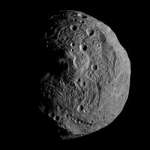 Virtual Flight over Asteroid Vesta
30.06.2019
What would it be like to fly over the asteroid Vesta? Animators from the German Aerospace Center took actual images and height data from NASA's Dawn mission when it visited asteroid Vesta a few years ago and generated a virtual movie.
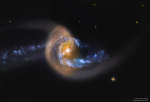 NGC 7714: Starburst after Galaxy Collision
9.10.2019
Is this galaxy jumping through a giant ring of stars? Probably not. Although the precise dynamics behind the featured image is yet unclear, what is clear is that the pictured galaxy, NGC 7714, has been stretched and distorted by a recent collision with a neighboring galaxy.
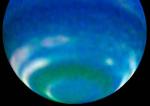 Neptune: Still Springtime After All These Years
13.06.2003
In the 1960s spring came to the southern hemisphere of Neptune, the Solar System's outermost gas giant planet. Of course, since Neptune orbits the Sun once every 165 earth-years, it's still spring for southern Neptune, where each season lasts over four decades.
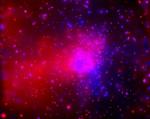 X Rays from M17
21.08.2003
About 5,000 light-years away, toward the constellation Sagittarius and the center of our galaxy, lies the bright star forming region cataloged as M17. In visible light, M17's bowed and hollowed-out appearance has resulted in many popular names like the Horseshoe, Swan, Omega, and Lobster nebula. But what has sculpted this glowing gas cloud?
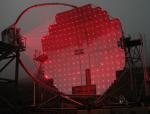 Night MAGIC
15.10.2004
Is it magic? On a rare foggy night, mysterious laser beams seem to play across the MAGIC telescope at Roque de los Muchachos on the Canary Island of La Palma. The lasers are actually part of a system designed to automatically adjust the focusing of the inovative, seventeen meter wide, multi-mirrored instrument.
|
January February March April May June July August September |
|||||||||||||||||||||||||||||||||||||||||||||||||