
|
You entered: image
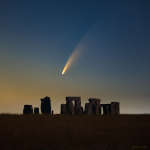 Comet NEOWISE over Stonehenge
14.07.2020
Have you ever seen a comet? Tonight -- and likely the next few nights -- should be a good chance. Go outside just at sunset and look to your northwest. The lower your horizon, the better. Binoculars may help, but if your sky is cloudless and dark, all you should need is your unaided eyes and patience.
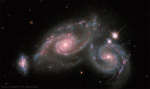 APOD: 2023 January 23 Б The Colliding Spiral Galaxies of Arp 274
23.01.2023
Two galaxies are squaring off in Virgo and here are the latest pictures. When two galaxies collide, the stars that compose them usually do not. This is because galaxies are mostly empty space and, however bright, stars only take up only a small fraction of that space.
 APOD: 2023 October 3 Б MyCn 18: The Engraved Hourglass Planetary Nebula
3.10.2023
Do you see the hourglass shape -- or does it see you? If you can picture it, the rings of MyCn 18 trace the outline of an hourglass -- although one with an unusual eye in its center. Either way, the sands of time are running out for the central star of this hourglass-shaped planetary nebula.
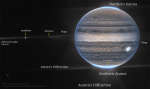 APOD: 2026 January 18 Б Jupiter from the Webb Space Telescope
18.01.2026
This infrared view of Jupiter by Webb is illuminating. High-resolution infrared images of Jupiter from the James Webb Space Telescope (Webb) reveal, for example, differences between high-floating bright clouds -- including the Great Red Spot -- and low-lying dark clouds.
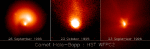 Comet Hale-Bopp Inbound
19.12.1996
Headed toward the inner Solar System, the much anticipated Comet Hale-Bopp has promised to put on a big show next spring. The comet's apparent brightness is currently approaching 4th magnitude and its inbound journey has been closely followed by many observers.
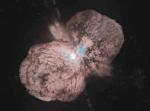 Doomed Star Eta Carinae
28.11.2004
Eta Carinae may be about to explode. But no one knows when - it may be next year, it may be one million years from now. Eta Carinae's mass - about 100 times greater than our Sun - makes it an excellent candidate for a full blown supernova.
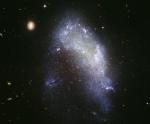 NGC 1427A: Galaxy in Motion
4.03.2005
In this tantalizing image, young blue star clusters and pink star-forming regions abound in NGC 1427A, a galaxy in motion. The small irregular galaxy's swept back outline points toward the top of this...
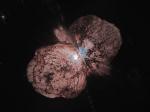 Doomed Star Eta Carinae
26.03.2006
Eta Carinae may be about to explode. But no one knows when - it may be next year, it may be one million years from now. Eta Carinae's mass - about 100 times greater than our Sun - makes it an excellent candidate for a full blown supernova.
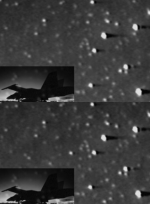 Astronomy From An F-18
28.01.2000
In an era of blossoming ground and space-based observatories, astronomers are also pushing the envelope with airborne instrumentation - successfully capturing an asteroid occultation from a high performance jet aircraft. This blinking animation represents...
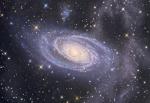 M81 in Ursa Major
27.04.2007
One of the brightest galaxies in planet Earth's sky and similar in size to the Milky Way, big, beautiful spiral M81 lies 11.8 million light-years away in the northern constellation Ursa Major. This...
|
January February March April May June July August September |
|||||||||||||||||||||||||||||||||||||||||||||||||