
|
You entered: image
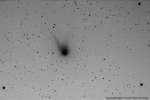 Introducing Comet Garradd
27.07.2011
Another large snowball is falling toward the Sun. Comet Garradd was discovered two years ago by Gordon Garradd in Australia, and is currently visible through a small telescope at visual magnitude nine. Officially designated...
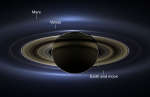 In the Shadow of Saturn
13.11.2013
In the shadow of Saturn, unexpected wonders appear. The robotic Cassini spacecraft now orbiting Saturn drifted in giant planet's shadow earlier this year and looked back toward the eclipsed Sun. Cassini saw a unique and celebrated view.
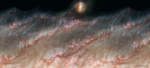 Unwinding M51
20.08.2020
The arms of a grand design spiral galaxy 60,000 light-years across are unwound in this digital transformation of the magnificent 2005 Hubble Space Telescope portrait of M51. In fact...
 APOD: 2024 March 31 Б Total Solar Eclipse Below the Bottom of the World
30.03.2024
In late 2021 there was a total solar eclipse visible only at the end of the Earth. To capture the unusual phenomenon, airplanes took flight below the clouded seascape of Southern Ocean. The featured...
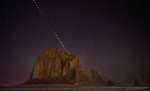 APOD: 2026 March 5 Б Total Lunar Eclipse over Tse Bitai
4.03.2026
Earlier this week, EarthБs shadow swept across the full Moon in the yearБs only total lunar eclipse. This stunning sequence combines images showing the MoonБs path across the night sky. Each lunar image captures our planetБs shadow gradually engulfing the Moon, culminating in its red glow.
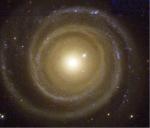 The Spiral Arms of NGC 4622
24.01.2002
While stirring a morning cup of coffee and thinking cosmic thoughts many astronomers would glance at this Hubble Space Telescope image of spiral galaxy NGC 4622 and assume that the galaxy was rotating counterclockwise in the picture.
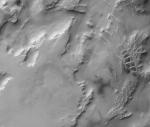 Rectangular Ridges on Mars
1.10.2002
What could cause rectangular ridges on Mars? As data flows in from the two spacecraft currently orbiting Mars, surface structures are seen that are not immediately understood. These structures pose puzzles that planetary geologists are eager to solve, as they might provide clues to past processes that have shaped Mars over billions of years.
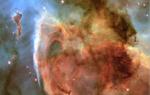 Colorful Clouds Of Carina
2.02.2000
Tumultuous clouds of the Carina Nebula, 8000 light-years away, glow in planet Earth's southern sky. Striking and detailed, this close-up of a portion of the famous nebula is a combination of exposures through six different filters taken with the Hubble Space Telescope's Wide Field Planetary Camera 2 in April of 1999.
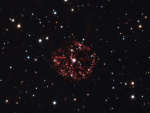 GK Per: Nova of 1901
5.11.2011
Early in the 20th century, GK Persei briefly became one of the brightest stars in planet Earth's sky, an event known as Nova Persei 1901. Documented in this modern day composite of two images from 2003 and 2011 the ejecta from the explosion, popularly called the Firework Nebula, continues to expand into space.
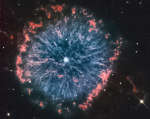 NGC 6751: The Glowing Eye Nebula
13.03.2013
Planetary nebulae can look simple, round, and planet-like in small telescopes. But images from the orbiting Hubble Space Telescope have become well known for showing these fluorescent gas shrouds of dying Sun-like stars to possess a staggering variety of detailed symmetries and shapes.
|
January February March April May June July August September |
|||||||||||||||||||||||||||||||||||||||||||||||||