
|
You entered: sky
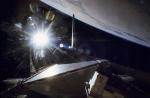 The Equal Night
23.09.2007
Today, the Sun crosses the celestial equator heading south at 0951 UT. Known as the equinox, the astronomical event marks the first day of autumn in the northern hemisphere and spring in the south.
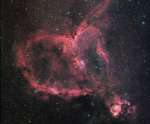 IC 1805: The Heart Nebula
14.02.2009
Sprawling across almost 200 light-years, emission nebula IC 1805 is a mix of glowing interstellar gas and dark dust clouds. Derived from its Valentine's-Day-approved shape, its nickname is the Heart Nebula. About 7,500 light-years away in the Perseus spiral arm of our galaxy, stars were born in IC 1805.
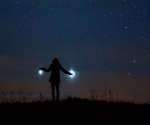 Jupiter and Venus from Earth
18.03.2012
It was visible around the world. The sunset conjunction of Jupiter and Venus was visible last week almost no matter where you lived on Earth. Anyone on the planet with a clear western horizon at sunset could see them. This week the two are still notable, even though Jupiter has sunk below the brighter Venus.
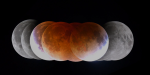 Time Lapse of a Total Lunar Eclipse
28.04.2014
Why would a bright full Moon suddenly become dark? Because it entered the shadow of the Earth. Almost two weeks ago this exact event happened as the Moon underwent a total lunar eclipse. That...
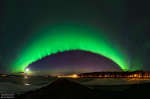 Aurora over Sweden
3.05.2016
It was bright and green and stretched across the sky. This striking aurora display was captured last month just outside of жstersund, Sweden. Six photographic fields were merged to create the featured panorama spanning almost 180 degrees. Particularly striking aspects of this aurora include its sweeping arc-like shape and its stark definition.
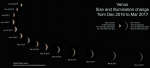 Phases of Venus
17.03.2017
Just as the Moon goes through phases, Venus' visible sunlit hemisphere waxes and wanes. This composite of telescopic images illustrates the steady changes for the inner planet, seen in the west as the evening star, as Venus grows larger but narrows to a thin crescent from December 20, 2016 through March 10.
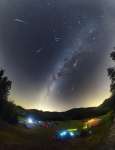 Night of the Perseids
10.08.2017
This weekend, meteors will rain down near the peak of the annual Perseid Meteor Shower. Normally bright and colorful, the Perseid shower meteors are produced by dust swept up by planet Earth from the orbit of Comet Swift-Tuttle. They streak from a radiant in Perseus, above the horizon in clear predawn skies.
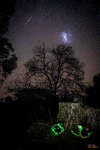 Ghost Fungus to Magellanic Cloud
23.05.2020
Stars shine and satellites glint in this clear, dark, night sky over Wannon Falls Reserve, South West Victoria, Australia. In fact the fuzzy, faint apparition above the tree tops is the only cloud visible, also known as the Large Magellanic Cloud, satellite galaxy of our own Milky Way.
 Structure in the Tail of Comet 12P/Pons Brooks
16.02.2024
Heading for its next perihelion passage on April 21, Comet 12P/Pons-Brooks is growing brighter. The greenish coma of this periodic Halley-type comet has become relatively easy to observe in small telescopes. But the bluish...
 APOD: 2025 February 5 Б Comet G3 ATLAS Setting over a Chilean Hill
5.02.2025
Where is Comet ATLAS going? In the featured time-lapse video, the comet is not itself moving very much, but the Earth's rotation makes it appear to be setting over a hill. The Comet C/2024 G3 (ATLAS) sequence was captured with an ordinary camera on January 22 from the Araucanцa Region in central Chile.
|
January February March April May June July August September October |
|||||||||||||||||||||||||||||||||||||||||||||||||