
|
You entered: sky
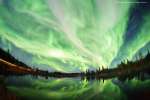 September s Aurora
23.09.2011
September's equinox arrives today at 0905 UT. As the Sun crosses the celestial equator heading south, spring begins in the southern hemisphere and autumn in the north. And though the seasonal connection is still puzzling, both spring and autumn bring an increase in geomagnetic storms.
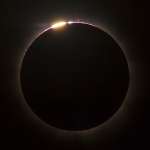 Solar Eclipse over Queensland
15.11.2012
This month's New Moon brought a total solar eclipse to parts of planet Earth on November 13 (UT). Most of the total eclipse track fell across the southern Pacific, but the Moon's dark umbral shadow began its journey in northern Australia on Wednesday morning, local time.
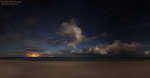 Moonbow Beach
6.09.2014
Like a rainbow at night, a beautiful moonbow shines above the western horizon in this deserted beach scene from Molokai Island, Hawaii, USA, planet Earth. Captured last June 17 in early morning hours, the lights along the horizon are from Honolulu and cities on the island of Oahu some 30 miles away.
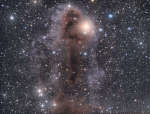 Lynds Dark Nebula 1251
31.05.2019
Stars are forming in Lynds Dark Nebula (LDN) 1251. About 1,000 light-years away and drifting above the plane of our Milky Way galaxy, the dusty molecular cloud is part of a complex of dark nebulae mapped toward the Cepheus flare region.
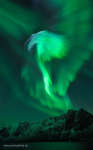 Eagle Aurora over Norway
14.07.2019
What's that in the sky? An aurora. A large coronal mass ejection occurred on our Sun five days before this 2012 image was taken, throwing a cloud of fast moving electrons, protons, and ions toward the Earth.
 A Black Hole Disrupts a Passing Star
24.03.2020
What happens to a star that goes near a black hole? If the star directly impacts a massive black hole, then the star falls in completely -- and everything vanishes. More likely, though, the star...
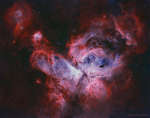 The Great Nebula in Carina
25.04.2022
In one of the brightest parts of Milky Way lies a nebula where some of the oddest things occur. NGC 3372, known as the Great Nebula in Carina, is home to massive stars and changing nebulas. The Keyhole Nebula (NGC 3324), the bright structure just below the image center, houses several of these massive stars.
 APOD: 2025 August 16 Б A Cool GIF of a 2025 Perseid
16.08.2025
The camera battery died about 2am local time on August 12, while shooting in the bright moonlit skies from a garden in Chastre, Brabant Wallon, Belgium, planet Earth. But not before it captured...
 Sun and Winter Solstice 1996
21.12.1996
Today is the Winter Solstice for 1996. After steadily sinking in Northern Hemisphere skies, the Sun is now at its lowest declination - marking the first day of Northern Winter (but Southern Summer!). The Earth...
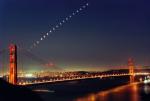 Copper Moon, Golden Gate
21.05.2003
When the Moon rose over San Francisco's Golden Gate Bridge on May 15, both bridge and Moon were in already in Earth's shadow. Of course, the bridge is in the Earth's shadow nightly, while the Moon only has that opportunity twice a year, during a lunar eclipse.
|
January February March April May June July August September October |
|||||||||||||||||||||||||||||||||||||||||||||||||