
|
You entered: sky
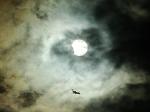 Clouds, Plane, Sun, Eclipse
11.04.2005
How can part of the Sun just disappear? When that part is really hiding behind the Moon. Last Friday, the first partial solar eclipse of 2005 and the last total eclipse of the Sun until March 2006 was visible. During a solar eclipse, the Sun, Moon and Earth are aligned.
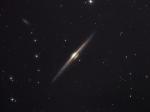 NGC 4565: Galaxy on the Edge
8.07.2005
Magnificent spiral galaxy NGC 4565 is viewed edge-on from planet Earth. Also known as the Needle Galaxy for its narrow profile, bright NGC 4565 is a stop on many telescopic tours of the northern sky as it lies in the faint but well-groomed constellation Coma Berenices.
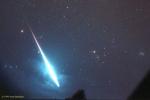 1999 Leonid Fireball
2.12.1999
Most Leonid meteoroids, the bits of comet debris which produce the annual Leonid meteor shower, range from a mere millimeter to a centimeter in diameter. Yet these cosmic grains of sand and gravel can put on quite a spectacular show. How can something so small generate so much light?
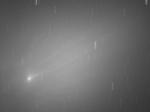 The Inner Coma of Comet Holmes
13.11.2007
What's happening to Comet Holmes? The rare comet remains visible to the unaided eyes of northern observers as an unusual small puff ball in the constellation of Perseus. A high resolution set of images of the comet's inner coma, taken last week and shown above, reveals significant detail.
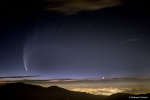 Comet McNaught Over Chile
20.01.2008
Comet McNaught was perhaps the most photogenic comet of our time. After making quite a show in the northern hemisphere in early January, the comet moved south and developed a long and unusual dust tail that dazzled southern hemisphere observers. In this image, Comet McNaught was captured one year ago above Chile.
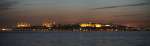 Moon over Byzantium
15.03.2008
Hiding near the Sun, a slender crescent Moon is a difficult but rewarding sight. Look to the right (scroll right) and you can spot one in this twilight panorama across the Bosporus Strait and along the skyline of the historic city of Istanbul. Recorded on March 8, the Moon is a mere 22 hours young.
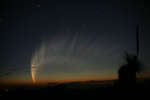 The Magnificent Tail of Comet McNaught
6.12.2009
Comet McNaught, the Great Comet of 2007, was the brightest comet of the last 40 years. Its spectacular tail spread across the sky and was breathtaking to behold from dark locations for many Southern Hemisphere observers.
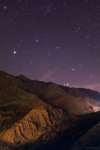 Regulus and the Red Planet
10.06.2010
Leo's royal star Regulus and red planet Mars appear in a colorful pairing just above the horizon in this starry skyscape. The photo was taken on June 4th from Oraman, a mountainous region of Kurdistan in western Iran near the border with Iraq.
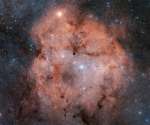 IC 1396: Emission Nebula in Cepheus
5.08.2012
Stunning emission nebula IC 1396 mixes glowing cosmic gas and dark dust clouds in the high and far off constellation of Cepheus. Energized by the bright, bluish central star seen here, this star forming region sprawls across hundreds of light-years -- spanning over three degrees on the sky while nearly 3,000 light-years from planet Earth.
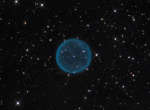 Spherical Planetary Nebula Abell 39
8.10.2012
Ghostly in appearance, Abell 39 is a remarkably simple, spherical nebula about five light-years across. Well within our own Milky Way galaxy, the cosmic sphere is roughly 7,000 light-years distant toward the constellation Hercules.
|
January February March April May June July August September October |
|||||||||||||||||||||||||||||||||||||||||||||||||