
|
You entered: sky
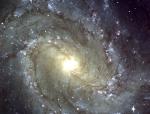 M83: The Southern Pinwheel Galaxy from VLT
6.12.1999
M83 is one of the closest and brightest spiral galaxies on the sky. Visible with binoculars in the constellation of Hydra, majestic spiral arms have prompted its nickname as the Southern Pinwheel. Although discovered...
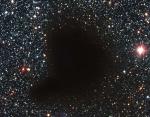 Molecular Cloud Barnard 68
23.09.2001
Where did all the stars go? What used to be considered a hole in the sky is now known to astronomers as a dark molecular cloud. Here, a high concentration of dust and molecular gas absorb practically all the visible light emitted from background stars.
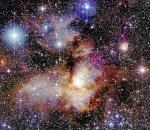 Star-Forming Region RCW38 from 2MASS
17.07.2002
The star cluster in RCW38 was hiding. Looking at the star forming region RCW38 will not normally reveal most of the stars in this cluster. The reason is that the open cluster is so young that it is still shrouded in thick dust that absorbs visible light.
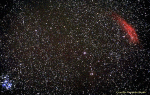 Seven Sisters Versus California
18.06.1996
In the lower left corner, dressed in blue, is the Pleiades. Also known as the Seven Sisters and M45, the Pleiades is one of the brightest and most easily visible open clusters on the sky. The Pleiades contains over 3000 stars, is about 400 light years away, and only 13 light years across.
 A Network of Microlensing Caustics
15.12.2002
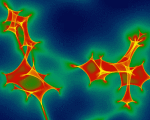
A virtual sky map like this would be of interest to astronomers studying gravitational microlensing. In microlensing, the gravity of stars near the line of sight can act to magnify the light of background objects such as distant stars, or quasars. Nowhere is this magnification greater than near a gravitational lensing caustic.
 Swirls and Stars in IC 4678
24.05.2005
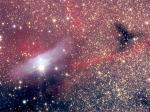
Swirls of gas and dust enrich this little observed starfield toward the constellation of Sagittarius. Just to the side of the more often photographed Lagoon Nebula (M8) and the Trifid Nebula (M20) lies this busy patch of sky dubbed IC 4678.
 Three Planets from Mt Hamilton
30.06.2005
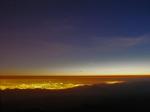
Venus, Mercury, and Saturn wandered close together in western evening skies last week. On Saturnday, June 25, astronomer R. Jay GaBany recorded this snapshot of their eye-catching planetary conjunction, from historic Lick Observatory on Mt. Hamilton, California, USA.
 Perseid Meteors and the Milky Way
15.08.2005
Where will the next Perseid meteor appear? Sky enthusiasts who trekked outside for the Perseid meteor shower that peaked over the past few days typically had this question on their mind. The above movie, where the time-line has been digitally altered, captures part of that very mystery.
 Shadow Set
4.02.2006
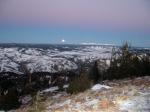
A nearly full Moon and planet Earth's shadow set together in this scene captured on January 13th from snowy Mt. Jelm, home of the Wyoming Infrared Observatory. For early morning risers (and late...
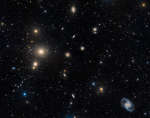 The Fornax Cluster of Galaxies
11.01.2013
How do clusters of galaxies form and evolve? To help find out, astronomers continue to study the second closest cluster of galaxies to Earth: the Fornax cluster, named for the southern constellation toward which most of its galaxies can be found.
|
January February March April May June July August September October |
|||||||||||||||||||||||||||||||||||||||||||||||||