
|
You entered: sky
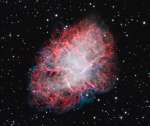 M1: The Incredible Expanding Crab
5.09.2013
The Crab Nebula is cataloged as M1, the first on Charles Messier's famous list of things which are not comets. In fact, the Crab is now known to be a supernova remnant, an expanding cloud of debris from the explosion of a massive star.
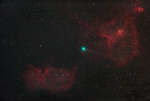 Comet Jacques, Heart and Soul
22.08.2014
On July 13th, a good place to watch Comet Jacques was from Venus. Then, the recently discovered visitor (C/2014 E2) to the inner solar system passed within about 14.5 million kilometers of our sister planet.
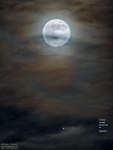 Moons and Jupiter
13.04.2017
On April 10, a Full Moon and Jupiter shared this telephoto field of view. Both were near opposition, opposite the Sun in Earth's night sky. Captured when a passing cloud bank dimmmed...
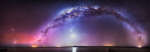 From the Northern to the Southern Cross
27.01.2019
There is a road that connects the Northern to the Southern Cross but you have to be at the right place and time to see it. The road, as pictured here, is actually...
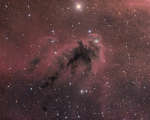 LDN 1622: Dark Nebula in Orion
2.02.2019
The silhouette of an intriguing dark nebula inhabits this cosmic scene. Lynds' Dark Nebula (LDN) 1622 appears against a faint background of glowing hydrogen gas only easily seen in long telescopic exposures of the region.
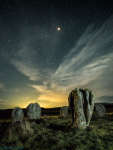 Mars over Duddo Stone Circle
23.03.2021
Why are these large stones here? One the more famous stone circles is the Duddo Five Stones of Northumberland, England. Set in the open near the top of a modest incline, a short hike across empty fields will bring you to unusual human -sized stones that are unlike anything surrounding them.
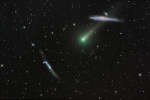 Comet Leonard and the Whale Galaxy
3.12.2021
Sweeping through northern predawn skies, on November 24 Comet Leonard (C/2021 A1) was caught between two galaxies in this composite telescopic image. Sporting a greenish coma the comet's dusty tail seems to harpoon the heart of NGC 4631 (top) also known as the Whale Galaxy.
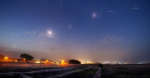 Planets of the Solar System
25.06.2022
Simultaneous images from four cameras were combined to construct this atmospheric predawn skyscape. The cooperative astro-panorama captures all the planets of the Solar System, just before sunrise on June 24. That foggy morning found innermost planet Mercury close to the horizon but just visible against the twilight, below and left of brilliant Venus.
 Stardust and Comet Tails
20.08.2022
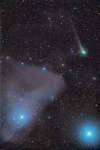
Heading for its closest approach to the Sun, or perihelion, on December 19 comet C/2017 K2 (PanSTARRS) remains a sight for telescopic observers as it sweeps through planet Earth's skies in the constellation Scorpius.
 Stereo Jupiter near Opposition
24.11.2023
Jupiter looks sharp in these two rooftop telescope images. Both were captured on November 17 from Singapore, planet Earth, about two weeks after Jupiter's 2023 opposition. Climbing high in midnight skies the giant planet was a mere 33.4 light-minutes from Singapore. That's about 4 astronomical units away.
|
January February March April May June July August September October |
|||||||||||||||||||||||||||||||||||||||||||||||||