
|
You entered: orbit
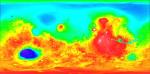 Topographical Mars
28.05.1999
Contrasting colors trace changing elevations in this new high-resolution topographic map of Mars. Just released, the data were gathered in 1998 and 1999 by the Mars Orbiter Laser Altimeter (MOLA) onboard the Mars Global Surveyor spacecraft.
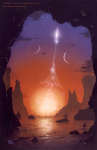 Dawn Before Nova
17.11.2009
Will this dawn bring another nova? Such dilemmas might be pondered one day by future humans living on a planet orbiting a cataclysmic variable binary star system. Cataclysmic variables involve gas falling from a large star onto an accretion disk surrounding a massive but compact white dwarf star.
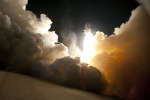 Night Launch of the Space Shuttle Endeavour
9.02.2010
Sometimes, the space shuttle launches at night. Pictured above, the space shuttle Endeavour lifted off in yesterday's early morning hours from Launch Pad 39A in Kennedy Space Center, Florida, USA, bound for the International Space Station (ISS).
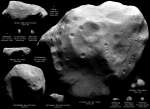 Lutetia: The Largest Asteroid Yet Visited
26.07.2010
As humans explore the universe, the record for largest asteroid visited by a spacecraft has increased yet again. Earlier this month, ESA's robotic Rosetta spacecraft zipped past the asteroid 21 Lutetia taking data and snapping images in an effort to better determine the history of the asteroid and the origin of its unusual colors.
 The Sand Dunes of Titan
10.08.2010
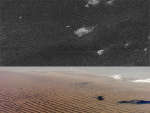
Why do some sand dunes on Titan appear backwards? Central Titan, it turns out, is covered by sand, some of which appears strange. Images from the Cassini spacecraft currently orbiting Saturn have uncovered long rows of huge sand dunes near Titan's equator that rise as high as 300 meters.
 Stardust and Betelgeuse
28.06.2011
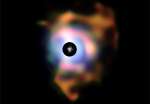
An expansive nebula of dust is seen to surround red supergiant star Betegeuse in this remarkable high resolution composite, an infrared VLT image from the European Southern Observatory. Betelgeuse itself is outlined by the small, central red circle. If found in our own solar system its diameter would almost encompass the orbit of Jupiter.
 Star Forming Region S106
7.11.2011
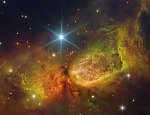
Massive star IRS 4 is beginning to spread its wings. Born only about 100,000 years ago, material streaming out from this newborn star has formed the nebula dubbed Sharpless 2-106 Nebula (S106), pictured above.
 Antares Rocket Launch
21.09.2013
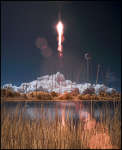
The sky looks dark in this scene from the Mid-Atlantic Regional Spaceport (MARS) at NASA Wallops Flight Facility, Virginia. Captured on Wednesday, September 18, an Orbital Sciences Corporation Antares rocket is leaving launch pad-0A with the Cygnus cargo spacecraft aboard.
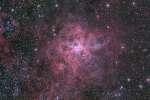 The Cosmic Web of the Tarantula Nebula
17.02.2014
It is the largest and most complex star forming region in the entire galactic neighborhood. Located in the Large Magellanic Cloud, a small satellite galaxy orbiting our Milky Way galaxy, the region's spidery appearance is responsible for its popular name, the Tarantula nebula. This tarantula, however, is about 1,000 light-years across.
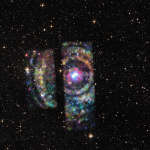 X ray Echoes from Circinus X 1
5.08.2015
Circinus X-1 is an X-ray binary star known for its erratic variability. In the bizarre Circinus X-1 system, a dense neutron star, the collapsed remnant of a supernova explosion, orbits with a more ordinary stellar companion.
|
January February March April May June July August September |
|||||||||||||||||||||||||||||||||||||||||||||||||