
|
You entered: orbit
 APOD: 2025 January 7 Б A New Years Aurora and SAR Arc
6.01.2025
It was a new year, and the sky was doubly red. The new year meant that the Earth had returned to its usual place in its orbit on January 1, a place a few days before its closest approach to the Sun.
 Ares 3 Landing Site: The Martian Revisited
16.05.2025
This close-up from the Mars Reconnaissance Orbiter's HiRISE camera shows weathered craters and windblown deposits in southern Acidalia Planitia. A striking shade of blue in standard HiRISE image colors, to the human eye the area would probably look grey or a little reddish.
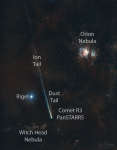 APOD: 2026 May 10 Б Comet R3 PanSTARRS and Orion
9.05.2026
Orion never had a sword like this. As Comet C/2025 R3 (PanSTARRS) heads out of the inner Solar System, it is putting on quite a show for long exposure cameras. Currently seen toward the constellation of Orion the Hunter, the distant Orion Nebula is visible on the upper right.
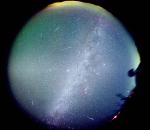 A Sky Filled with Leonids
4.12.2001
In the early morning hours of November 19, amateur Chen Huang-Ming caught a sky filled with astronomical wonders. With his fisheye camera set up on Ho-Huan Mountain in Taiwan for a half-hour exposure, he started the above image a local time of 2:33 am.
 Valles Marineris Perspective from Mars Express
28.01.2004
Europe's Mars Express satellite has started returning detailed color images of the red planet. The first of the current armada to arrive at Mars, the orbiting satellite will photograph the entire Martian surface...
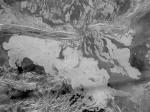 Lava Flows on Venus
22.03.2004
The hot surface of Venus shows clear signs of ancient lava flows. Evidence of this was bolstered by the robot spacecraft Magellan, which orbited Venus in the early 1990s. Using imaging radar, Magellan was able to peer beneath the thick perpetual clouds that cover Earth's closest planetary neighbor.
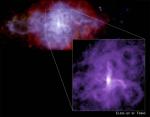 3C58: Pulsar Power
22.12.2004
Light from a star that exploded some ten thousand light-years away first reached our fair planet in the year 1181. Now known as supernova remnant 3C58, the region seen in this false-color image glows in x-rays, powered by a rapidly spinning neutron star or pulsar - the dense remains of the collapsed stellar core.
 A Giant Gouge on Asteroid Eros
20.02.2000
Asteroid 433 Eros is posing several riddles. NASA's robot spacecraft NEAR began orbiting the 30-kilometer space rock last week, and new pictures are now being beamed back to Earth regularly. As usual in science, when you arrive at a place you've never been before, you see things you don't immediately understand.
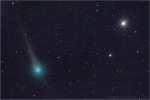 Lulin and Saturn near Opposition
26.02.2009
Tracking through the constellation Leo on February 23rd, bright planet Saturn and Comet Lulin were both near opposition -- opposite the Sun in planet Earth's sky. They also passed within only 2 degrees of each other creating a dramatic celestial photo-op.
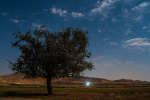 Perseid in Moonlight
15.08.2014
Bright moonlight from a Full Moon near perigee illuminates the night and casts shadows in this skyscape from central Iran. Taken on August 12, near the peak of the annual Perseid meteor shower the exposure also captures a bright and colorful perseid streak above the shady tree in the foreground.
|
January February March April May June July August September |
|||||||||||||||||||||||||||||||||||||||||||||||||