
|
You entered: orbit
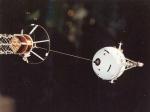 A Tether in Space
28.03.2005
One of the greatest unrequited legends of outer space is the tether. Tethers, long strands of material, hold the promise of stabilizing satellites, generating electricity, and allowing easy transportation. Possibly the most extreme vision of the space tether is the space elevator popularized by Arthur C.
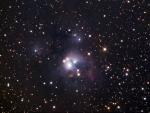 Young Suns of NGC 7129
11.08.2005
Young suns still lie within dusty NGC 7129, some 3,000 light-years away toward the royal constellation Cepheus. While these stars are at a relatively tender age, only about a million years old, it is likely that our own Sun formed in a similar stellar nursery some five billion years ago.
 Martian Dust Devil Trails
21.10.2009
Who's been marking up Mars? This portion of a recent high-resolution picture from the HiRISE camera on board the Mars Reconnaissance Orbiter shows twisting dark trails criss-crossing light colored terrain on the martian surface.
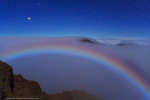 Mars and a Colorful Lunar Fog Bow
2.02.2010
Even from the top of a volcanic crater, this vista was unusual. For one reason, Mars was dazzlingly bright two weeks ago, when this picture was taken, as it was nearing its brightest time of the entire year. Mars, on the far upper left, is the brightest object in the above picture.
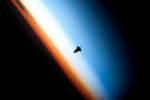 Dark Shuttle Approaching
16.02.2010
What's that approaching? Astronauts on board the International Space Station first saw it far in the distance. Soon it enlarged to become a dark silhouette. As it came even closer, the silhouette appeared to be a spaceship.
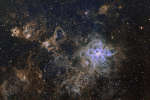 The Cosmic Web of the Tarantula Nebula
11.01.2011
It is the largest and most complex star forming region in the entire galactic neighborhood. Located in the Large Magellanic Cloud, a small satellite galaxy orbiting our Milky Way galaxy, the region's spidery appearance is responsible for its popular name, the Tarantula nebula. This tarantula, however, is about 1,000 light-years across.
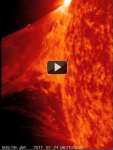 A Solar Prominence Eruption from SDO
7.03.2011
One of the most spectacular solar sights is an erupting prominence. Two weeks ago, NASA's Sun-orbiting Solar Dynamic Observatory spacecraft imaged an impressively large prominence erupting from the surface. The dramatic explosion...
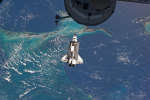 Atlantis Last Approach
13.07.2011
For the last time, the US Space Shuttle has approached the International Space Station (ISS). Following a dramatic launch from Cape Canaveral last week that was witnessed by an estimated one million people, Space Shuttle Atlantis on STS-135 lifted a small crew to a welcome rendezvous three days ago with the orbiting station.
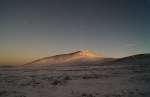 The Snows of Paranal
11.08.2011
Recorded last week, this dawn portrait of snowy mountain and starry sky captures a very rare scenario. The view does feature a pristine sky above the 2,600 meter high mountain Cerro Paranal, but clear skies over Paranal are not at all unusual.
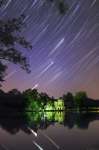 Trails in the Morning Sky
28.07.2012
Brilliant Venus and bright Jupiter still rise together before dawn. The peaceful waters by a small lakeside house near Stuttgart, Germany reflect their graceful arcing trails in this composited series of exposures, recorded on the morning of July 26.
|
January February March April May June July August September |
|||||||||||||||||||||||||||||||||||||||||||||||||