
|
You entered: orbit
 APOD: 2025 September 26 Б A SWAN an ATLAS and Mars
26.09.2025
A new visitor to the inner Solar System, comet C/2025 R2 (SWAN) sports a long ion tail extending diagonally across this almost 7 degree wide telescopic field of view recorded on September 21.
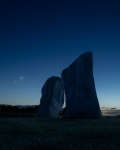 APOD: 2026 June 12 Б Venus and Jupiter: Conjunction from Avebury
12.06.2026
To see Venus and Jupiter together this month, you won't need binoculars or even a telescope. Just look up after sunset and you'll find them emerging as the sky grows dark near the western horizon.
 The Map Of Eros
26.10.2000
This map of Eros was constructed from a mosaic of images recorded by the NEAR Shoemaker spacecraft, currently orbiting the 40 x 14 x 14 kilometer asteroid. A simple cylindrical projection of an irregularly shaped world, the map's individual images don't always match up at the edges.
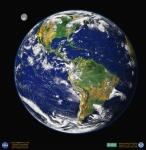 Blue Marble 2000
20.04.2000
This newly released digital portrait of our planet is reminiscent of the Apollo-era pictures of the "big blue marble" Earth from space. To create it, researchers at Goddard Space Flight Center's Laboratory...
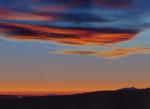 Mercury on the Horizon
12.04.2003
Have you ever seen the planet Mercury? Because Mercury orbits so close to the Sun, it never wanders far from the Sun in Earth's sky. If trailing the Sun, Mercury will be visible low on the horizon for only a short while before sunset.
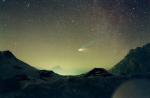 Comet Hale-Bopp Over Val Parola Pass
17.03.1997
Comet Hale-Bopp is now much brighter than any surrounding stars. It can be seen even over bright city lights. Out away from city lights, however, it is putting on quite a spectacular show. Here Comet Hale-Bopp was photographed last week above Val Parola Pass in the Dolomite mountains surrounding Cortina d'Ampezzo, Italy.
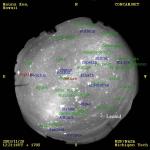 A Late Leonid from a Sparse Shower
25.11.2003
The 2003 Leonids Meteor Shower contained relatively few meteors. As expected and unlike the last few years, the Earth just did not pass through any dense particle streams left over by the Sun-orbiting Comet Tempel-Tuttle.
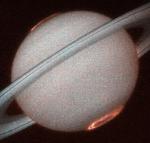 Saturnian Aurora
23.01.1999
Girdling the second largest planet in the Solar System, Saturn's Rings are one of the most spectacular sights for earthbound telescopes. This image from the orbiting Hubble Space Telescope's STIS instrument, offers a striking view of another kind of ring around Saturn - pole encircling rings of ultraviolet aurora.
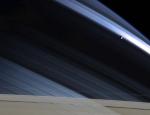 Mimas, Rings, and Shadows
2.12.2004
Caught in sunlight, icy moon Mimas shines above a broad shadow across gas giant Saturn. In this remarkable image from the Cassini spacecraft, tiny Mimas is at the upper right. The broad shadow across...
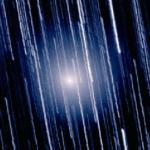 Tempel Tuttle: The Leonid Comet
13.11.1999
Star trails streak this composite time exposure of Comet Tempel-Tuttle recorded by T. Puckett on January 26, 1998. Then passing through the inner solar system on its 33 year orbit around the Sun, Tempel-Tuttle brightened unexpectedly, but binoculars or small telescopes were still required to visually observe it.
|
January February March April May June July August September |
|||||||||||||||||||||||||||||||||||||||||||||||||