
|
You entered: orbit
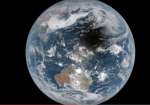 Moon Shadow versus Sun Reflection
17.07.2017
What are those lights and shadows crossing the Earth? As the featured five-second time-lapse video progresses, a full day on planet Earth is depicted as seen from Japan's Himawari-8 satellite in geostationary orbit high above the Pacific Ocean.
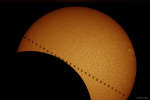 A Fleeting Double Eclipse of the Sun
28.08.2017
Last week, for a fraction of a second, the Sun was eclipsed twice. One week ago today, many people in North America were treated to a standard, single, partial solar eclipse. Fewer people, all congregated along a narrow path, experienced the eerie daytime darkness of a total solar eclipse.
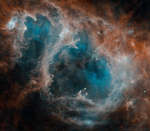 The Soul Nebula in Infrared from Herschel
4.10.2017
Stars are forming in the Soul of the Queen of Aethopia. More specifically, a large star forming region called the Soul Nebula can be found in the direction of the constellation Cassiopeia, who Greek mythology credits as the vain wife of a King who long ago ruled lands surrounding the upper Nile river.
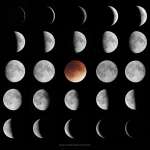 Phases of the Moon
10.03.2018
Look at the Moon every night and its visible sunlit portion gradually changes. In phases progressing from New Moon to Full Moon to New Moon again, a lunar cycle or lunation is completed in about 29.5 days.
 Rotating Moon from LRO
18.03.2018
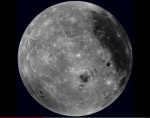
No one, presently, sees the Moon rotate like this. That's because the Earth's moon is tidally locked to the Earth, showing us only one side. Given modern digital technology, however, combined with many detailed images returned by the Lunar Reconnaissance Orbiter (LRO), a high resolution virtual Moon rotation movie has been composed.
 Spiraling Supermassive Black Holes
3.12.2018
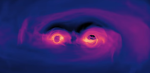
Do black holes glow when they collide? When merging, co-orbiting black holes are sure to emit a burst of unusual gravitational radiation, but will they emit light, well before that, if they are surrounded by gas? To help find out, astrophysicists created a sophisticated computer simulation.
 A View Toward M106
20.06.2019
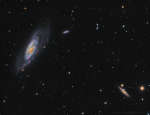
Big, bright, beautiful spiral, Messier 106 dominates this cosmic vista. The nearly two degree wide telescopic field of view looks toward the well-trained constellation Canes Venatici, near the handle of the Big Dipper. Also...
 Mercurys Sodium Tail
8.07.2020
What is that fuzzy streak extending from Mercury? Long exposures of our Solar System's innermost planet may reveal something unexpected: a tail. Mercury's thin atmosphere contains small amounts of sodium that glow when excited by light from the Sun. Sunlight also liberates these molecules from Mercury's surface and pushes them away.
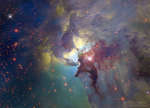 The Lively Center of the Lagoon Nebula
25.05.2022
The center of the Lagoon Nebula is a whirlwind of spectacular star formation. Visible near the image center, at least two long funnel-shaped clouds, each roughly half a light-year long, have been formed by extreme stellar winds and intense energetic starlight. A tremendously bright nearby star, Herschel 36, lights the area.
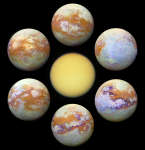 Seeing Titan
31.03.2023
Shrouded in a thick atmosphere, Saturn's largest moon Titan really is hard to see. Small particles suspended in the upper atmosphere cause an almost impenetrable haze, strongly scattering light at visible wavelengths and hiding Titan's surface features from prying eyes.
|
January February March April May June July August September |
|||||||||||||||||||||||||||||||||||||||||||||||||