
|
You entered: orbit
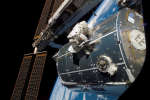 Columbus Laboratory Installed on Space Station
19.02.2008
The International Space Station (ISS) has been equipped with a powerful new scientific laboratory. The Space Shuttle Atlantis delivered the Columbus Laboratory to the ISS and installed the seven meter long module over the past week.
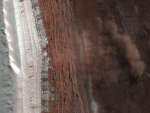 An Avalanche on Mars
11.03.2008
What caused this sudden cloud of dust on Mars? An avalanche! The first avalanche imaged in progress on another planet was recorded last month on Mars by NASA's robotic Mars Reconnaissance Orbiter. Visible...
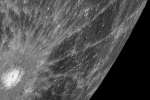 A Spectacular Rayed Crater on Mercury
3.11.2008
Why does Mercury have so many rayed craters? No one is sure. The robotic MESSENGER spacecraft that is taking unprecedented images as it swoops past the innermost planet has provided dramatic confirmation that Mercury has more rayed craters than Earth's Moon.
 Earth Rotating Under Very Large Telescopes
1.06.2011
Why is the Earth moving in the above video? Most time lapse videos of the night sky show the stars and sky moving above a steady Earth. Here, however, the frames have been digitally rotated so that it is the stars that stay (approximately) steady, and the Earth that moves beneath them.
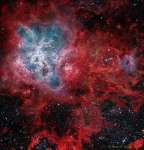 The Cosmic Web of the Tarantula Nebula
8.11.2016
It is the largest and most complex star forming region in the entire galactic neighborhood. Located in the Large Magellanic Cloud, a small satellite galaxy orbiting our Milky Way galaxy, the region's spidery appearance is responsible for its popular name, the Tarantula nebula. This tarantula, however, is about 1,000 light-years across.
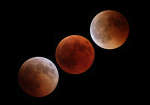 Central Lunar Eclipse
3.08.2018
Reddened by scattered sunlight, the Moon in the center is passing through the center of Earth's dark umbral shadow in this July 27 lunar eclipse sequence. Left to right the three images are from the start, maximum, and end to 103 minutes of totality from the longest lunar eclipse of the 21st century.
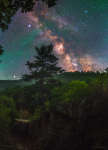 Firefly Milky Way over Russia
6.09.2021
It started with a pine tree. The idea was to photograph a statuesque pine in front of the central band of our Milky Way Galaxy. And the plan, carried out two months ago, was successful -- they both appear prominently. But the resulting 3-frame panorama captured much more.
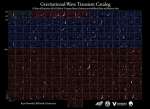 APOD: 2026 March 26 Б
26.03.2026
What is the sound of two black holes merging in deep space? Sound waves don't propagate in vacuum, but gravitational waves do. In 2015 we were able to "hear" them for the first time and confirm one of Albert Einstein's theoretical predictions.
 BATSE's Biggest Gamma Ray Burst (Yet)
1.10.1996
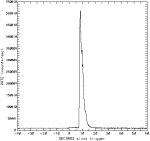
Something big exploded but astronomers have no idea what. On September 24th, the Burst and Transient Source Experiment (BATSE) onboard the orbiting Compton Gamma Ray Observatory recorded the most intense gamma ray burst in its five year history.
 The Shadow of Phobos
29.03.2003
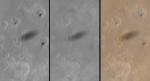
Hurtling through space above the Red Planet, potato-shaped Phobos completes an orbit of Mars in less than eight hours. In fact, since its orbital period is shorter than the planet's rotation period, Mars-based...
|
January February March April May June July August September |
|||||||||||||||||||||||||||||||||||||||||||||||||