
|
You entered: orbit
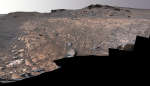 Perseverance in Jezero Crater s Delta
17.09.2022
The Perseverance rover's Mastcam-Z captured images to create this mosaic on August 4, 2022. The car-sized robot was continuing its exploration of the fan-shaped delta of a river that, billions of years ago, flowed into Jezero Crater on Mars.
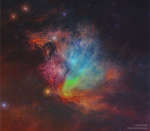 APOD: 2023 February 19 Б Seven Dusty Sisters in Infrared
19.02.2023
Is this really the famous Pleiades star cluster? Known for its iconic blue stars, the Pleiades is shown here in infrared light where the surrounding dust outshines the stars. Here three infrared colors have been mapped into visual colors (R=24, G=12, B=4.6 microns).
 APOD: 2024 September 30 Б Comet Tsuchinshan ATLAS over Mexico
30.09.2024
The new comet has passed its closest to the Sun and is now moving closer to the Earth. C/2023 A3 (TsuchinshanБATLAS) is currently moving out from inside the orbit of Venus and on track to pass its nearest to the Earth in about two weeks.
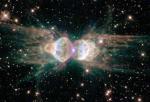 Planetary Nebula Mz3: The Ant Nebula
5.02.2001
Why isn't this ant a big sphere? Planetary nebula Mz3 is being cast off by a star similar to our Sun that is, surely, round. Why then would the gas that is streaming away create an ant-shaped nebula that is distinctly not round?
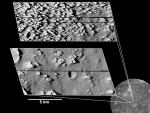 Jagged Hills on Jupiters Callisto
28.08.2001
Why does Jupiter's moon Callisto have unusual jagged hills? This mystery came to light after the robot spacecraft Galileo, in orbit around Jupiter since 1995, swooped past the dark moon in May. The resulting pictures were the highest resolution yet obtained for a Jovian moon: objects as small as 3 meters across are discernable.
 Stars Without Galaxies
3.02.1997
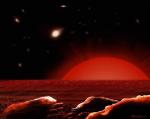
Galaxies are made up of stars, but are all stars found within galaxies? Apparently not. Using the Hubble Space Telescope, researchers exploring the Virgo Cluster of galaxies have now found about 600 red giant stars adrift in intergalactic space.
 Zubenelgenubi and Friends
14.05.2004
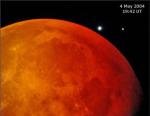
Moderately bright Zubenelgenubi is the star just off the upper right hand limb of an eclipsed Moon in this telescopic view from Port Elizabeth, South Africa. Actually the second brightest star in the constellation...
 Planetary Nebula Mz3: The Ant Nebula
1.05.2005
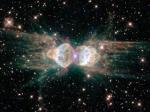
Why isn't this ant a big sphere? Planetary nebula Mz3 is being cast off by a star similar to our Sun that is, surely, round. Why then would the gas that is streaming away create an ant-shaped nebula that is distinctly not round?
 X Ray Portrait of Trumpler 14
2.09.2005
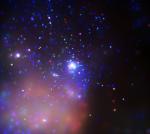
A wonder of planet Earth's southern sky, star cluster Trumpler 14 lies about nine thousand light-years away in the Carina complex -- a rich star forming region at the edge of a giant molecular cloud.
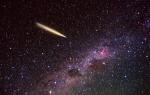 Mystery Over Australia
22.02.2007
Place your cursor on this stunning view of dark skies over western Australia to highlight wonders of the southern Milky Way -- including the famous Southern Cross, the dark Coal Sack Nebula, and bright reddish emission regions surrounding massive star Eta Carinae.
|
January February March April May June July August September |
|||||||||||||||||||||||||||||||||||||||||||||||||