
|
You entered: Voyager
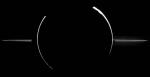 Jupiters Rings Revealed
16.09.1998
Why does Jupiter have rings? Jupiter's rings were discovered in 1979 by the passing Voyager 1 spacecraft, but their origin has always been a mystery. Recent data from the Galileo spacecraft currently orbiting Jupiter now confirms that these rings were created by meteoroid impacts on small nearby moons.
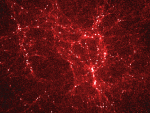 The Early Universe
14.06.1997
What did our universe look like when it was young? To answer this, cosmologists run sophisticated computer programs tracking the locations of millions of particles. The above animated frame is the result of such a calculation and shows how our universe might have looked when it was just a fracton of its current age.
 Dinkinesh Moonrise
4.11.2023
Last Wednesday the voyaging Lucy spacecraft encountered its first asteroid, 152830 Dinkinesh, and discovered the inner-main belt asteroid has a moon. From a distance of just over 400 kilometers, Lucy's Long-Range Reconnaissance Imager...
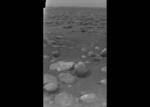 Huygens Images Titan s Surface
15.01.2005
After a seven year interplanetary voyage on board the the Cassini spacecraft, the European Space Agency's Huygens probe parachuted to a historic landing on Saturn's moon Titan on January 14. Above...
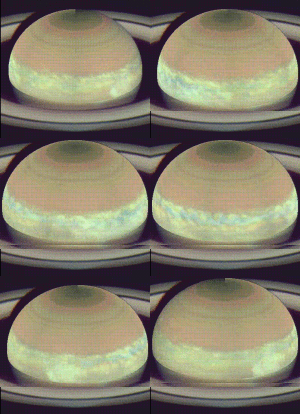 Saturn Rotates
3.10.2000
The dramatic rotation of the cloud-tops of Saturn every ten-hours is particularly evident from orbit around the gas giant planet. With a good enough telescope, however, such rotation is visible even from Earth, as shown by this time-lapse image sequence from the Hubble Space Telescope taken in November 1990.
 Venus: Just Passing By
25.06.2005
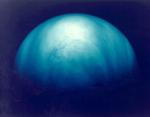
Venus, the second closest planet to the Sun, is by far the brightest of the three planets gathered in this weekend's western sky at sunset. It has also proven to be a popular way-point for spacecraft headed for the gas giant planets in the outer reaches of the solar system. Why visit Venus first?
 A Wind From The Sun
17.02.1997
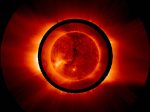
A wind from the Sun blows through our Solar System. The behaviour of comet tails as they flapped and waved in this interplanetary breeze gave astronomers the first hint of its existence. Streaming outward...
 Venus: Just Passing By
29.09.2002
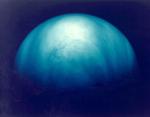
Venus, the second closest planet to the Sun, is a popular way-point for spacecraft headed for the gas giant planets in the outer reaches of the solar system. Why visit Venus first? Using...
 M17: A Hubble Close Up
25.04.2003
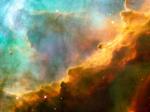
Sculpted by stellar winds and radiation, these fantastic, undulating shapes lie within the stellar nursery known as M17, the Omega Nebula, some 5,500 light-years away in the nebula-rich constellation Sagittarius. The lumpy features...
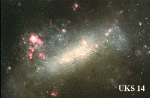 The Large Cloud Of Magellan (LMC)
24.01.1998
Ferdinand Magellan and his crew had plenty of time to study the southern sky during their famous voyage around the world. As a result, two fuzzy cloud-like objects, not visible to northern hemisphere dwellers, are now known as the Clouds of Magellan.
|
January February March April May June July August September October |
|||||||||||||||||||||||||||||||||||||||||||||||||