
|
You entered: Voyager
 APOD: 2026 August 5 Б Spokes on Saturn's B Ring
4.08.2026
DonБt get spooked by SaturnБs ghostly spokes! Today we feature a nearly two-hour timelapse of Saturn and its rings looping forwards and backwards. A day on Saturn is only 10 hours long, so two hours of observation covers quite a bit of its rotation.
 Happy Birthday Jules Verne
16.02.2001
One hundred seventy-three years ago on February 8th, Jules Verne was born in Nantes, France. Inspired by a lifelong fascination with machines, Verne wrote visionary works about "Extraordinary Voyages" including such terrestrial travels as Around the World in 80 Days, Journey to the Centre of the Earth, and Twenty Thousand Leagues Under the Sea.
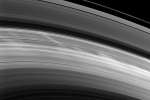 Spokes Reappear on Saturns Rings
2.06.2009
What causes the mysterious spokes in Saturn's rings? Visible in the above image as light ghostlike impressions, spokes were first discovered by the Voyager spacecraft that buzzed by Saturn in the early 1980s. Their existence was unexpected.
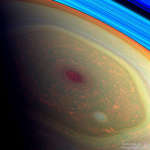 Saturns Northern Hexagon
4.07.2020
Why would clouds form a hexagon on Saturn? Nobody is sure. Originally discovered during the Voyager flybys of Saturn in the 1980s, nobody has ever seen anything like it anywhere else in the Solar System.
 APOD: 2023 June 18 Б Saturns Northern Hexagon
17.06.2023
Why would clouds form a hexagon on Saturn? Nobody is sure. Originally discovered during the Voyager flybys of Saturn in the 1980s, nobody has ever seen anything like it anywhere else in the Solar System.
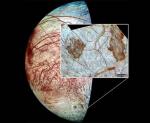 Galileo s Europa
19.09.2003
Launched in 1989 and looping through the jovian system since late 1995, the voyage of NASA's Galileo spacecraft will soon come to an end. The spacecraft has been targeted to plunge directly into Jupiter this Sunday, September 21st, at about 30 miles per second.
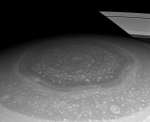 Saturns Hexagon and Rings
20.02.2013
Why would clouds form a hexagon on Saturn? Nobody is sure. Originally discovered during the Voyager flybys of Saturn in the 1980s, nobody has ever seen anything like it anywhere else in the Solar System.
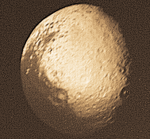 Iapetus: Saturn's Disappearing Moon
14.10.1995
Iapetus has an unusual surface, one half of which is very dark, the other half very light. This caused it's discoverer Cassini to remark that Iapetus could only be seen when on one side of Saturn but not the other. The reason for the difference between hemispheres is presently unknown.
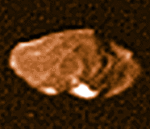 Jupiter's Moon Amalthea
2.11.1995
Amalthea is Jupiter's fifth largest moon, much smaller than the four Galilean satellites Io, Europa, Ganymede, and Callisto. The orbit of Amalthea is inside of these moons, and with its long axis always pointing toward Jupiter. It's dark surface color is probably due to sulfur being expelled from Io.
 Arp 230: Two Spirals in One?
31.08.1997
Is this one galaxy or two? Analysis of Arp 230 has shown evidence that this seemingly single spiral galaxy is actually the result of the recent collision of two spiral galaxies. The slow motion collision took place over about 100 million years and induced a burst of star formation that has begun to subside.
|
January February March April May June July August September October |
|||||||||||||||||||||||||||||||||||||||||||||||||