
|
You entered: Voyager
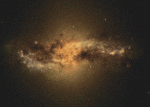 Arp 230: Two Spirals in One?
22.08.1996
Is this one galaxy or two? Analysis of Arp 230 has shown evidence that this seemingly single spiral galaxy is actually the result of the recent collision of two spiral galaxies. The slow motion collision took place over about 100 million years and induced a burst of star formation that has begun to subside.
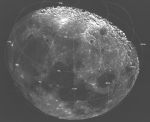 North to the Moon's Pole
22.06.1996
This image is from the voyage of the intrepid Galileo spacecraft as it passed above the Moon's north pole on its long journey to Jupiter. It was made over 60 years after Admiral Byrd became the first to fly over the Earth's north pole.
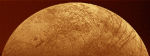 Europa: Ancient Water World
5.09.1995
Beneath the cold icy surface of Jupiter's moon Europa are probably the only oceans of water in our Solar System outside of Earth. These oceans, possibly 50 kilometers deep, might also be the most likely local place to find extra-terrestrial life.
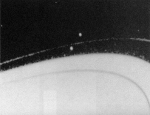 Prometheus, Pandora and Saturn's F Ring
23.12.1995
The third and fourth innermost moons of Saturn were unexpectedly discovered to be gravitational "shepards." The inner moon Prometheus and the outer moon Pandora use their gravitational attraction to define Saturn's outermost ring.
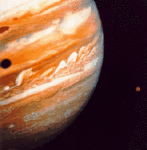 Jupiter, Io, and Ganymede's Shadow
13.10.1995
Jupiter, the solar system's largest planet, is seen here next to Io, its closest Galilean moon. On the cloud tops of Jupiter near the left edge of the picture can be seen a dark circular spot which is caused by the shadow of Jupiter's largest moon Ganymede.
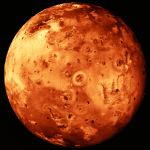 Io: A Volcanic Moon
3.08.1995
In 1610, Galileo turned his telescope to the heavens and discovered that the planet Jupiter had four bright moons. The innermost of these Galilean moons, Io, turned out to be one of the most exotic objects in the solar system.
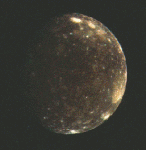 Callisto: Dark Smashed Iceball
6.09.1995
Callisto is a dirty battered world, showing the most beaten surface of Jupiter's major moons. Made of a rocky core covered by fractured ice, Callisto's past collisions with large meteors are evident as large craters surrounded by concentric rings.
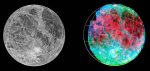 Fields of Minerals on Ganymede
7.11.1996
What treasures lie on the surface of Ganymede? Last week, NASA released a map of Jupiter's largest moon made by the Galileo Orbiter highlighting ice and minerals deposits. The leftmost photograph by Voyager...
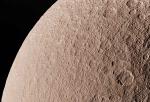 Rhea: Saturns Second Largest Moon
5.12.1999
Rhea is the second largest moon of Saturn, behind Titan, and the largest without an atmosphere. It is composed mostly of water ice, but has a small rocky core. Rhea's rotation and orbit are locked together (just like Earth's Moon) so that one side always faces Saturn.
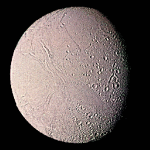 Saturn's Cleanest Moon: Enceladus
25.11.1995
Enceladus orbits Saturn between the smaller Mimas and the larger Tethys. Enceladus is composed mostly of water ice and has the cleanest and purest ice surface in the Solar System. It's surface therefore appears nearly white. The surface also has many unusual groves and relatively few craters, like Jupiter's moon Ganymede.
|
January February March April May June July August September October |
|||||||||||||||||||||||||||||||||||||||||||||||||