
|
You entered: Voyager
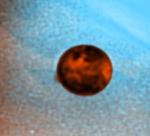 Eruption on Io
23.06.1997
There it goes again. Gas and rock were catapulted hundreds of kilometers into space as Jupiter's most volatile moon, Io, showed yet another impressive volcanic display in this just-released photograph by the Hubble Space Telescope.
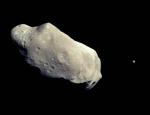 Ida and Dactyl: Asteroid and Moon
19.06.2004
This asteroid has a moon! The robot spacecraft Galileo destined to explore the Jovian system, encountered and photographed two asteroids during its long interplanetary voyage to Jupiter. The second asteroid it photographed, Ida, was discovered to have a moon which appears as a small dot to the right of Ida in this image from 1993.
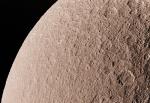 Rhea: Saturn's Second Largest Moon
8.06.2003
Rhea is the second largest moon of Saturn, behind Titan, and the largest without an atmosphere. It is composed mostly of water ice, but has a small rocky core. Rhea's rotation and orbit are locked together (just like Earth's Moon) so that one side always faces Saturn.
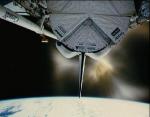 Shuttle Engine Blast
8.03.1998
The Space Shuttle Discovery's orbital maneuvering system (OMS) engine firing produced this dramatic flare as it cruised "upside down" in low Earth orbit. Discovery was named for a ship commanded by Captain James Cook RN, the 18th Century English astronomer and navigator.
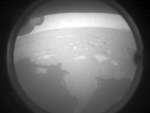 Mars Perseverance Sol 0
19.02.2021
After a 203 day interplanetary voyage, and seven minutes of terror, Perseverance has landed on Mars. Confirmation of the successful landing at Jezero crater was announced from mission control at NASAБs Jet Propulsion Laboratory in Southern California at 12:55 pm PST on February 18.
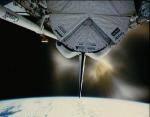 Shuttle Engine Blast
26.01.2002
The Space Shuttle Discovery's orbital maneuvering system (OMS) engine firing produced this dramatic flare as it cruised "upside down" in low Earth orbit. Discovery was named for a ship commanded by Captain James Cook RN, the 18th Century English astronomer and navigator.
 APOD: 2023 May 28 Б Ida and Dactyl: Asteroid and Moon
28.05.2023
This asteroid has a moon. The robot spacecraft Galileo on route to Jupiter in 1993 encountered and photographed two asteroids during its long interplanetary voyage. The second minor planet it photographed, 243 Ida, was unexpectedly discovered to have a moon.
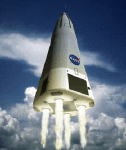 The Delta Clipper
28.10.1995
The Delta Clipper experimental rocket or DC-X is intended as a development vehicle to pave the way for a reusable single stage to orbit rocket. Shown here, in an artists conception, it has made...
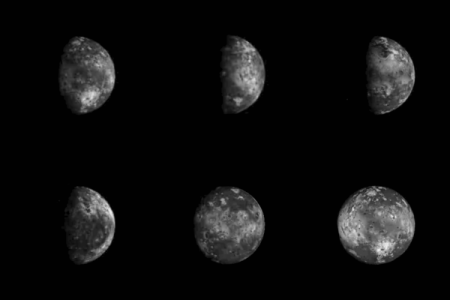 Io Rotating
31.12.1996
Are any volcanoes on Io currently erupting? To help answer this, scientists instructed the robot spacecraft Galileo to take hourly pictures of this moon of Jupiter prior to its most recent encounter. The most obvious changes in Io are due to the changing amount of sunlight reflected from the moon to the spacecraft.
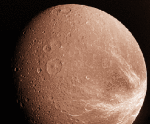 Saturn's Moon Dione
9.10.1995
Dione, one of Saturn's larger moons, is remarkable for its bright surface streaks. These streaks run across some of Dione's many craters, which indicate that the process which created the streaks occurred later than the process which created the craters.
|
January February March April May June July August September October |
|||||||||||||||||||||||||||||||||||||||||||||||||