
|
You entered: orbit
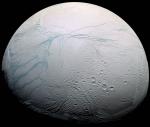 Fresh Tiger Strips on Saturns Enceladus
6.09.2005
The tiger stripes on Saturn's moon Enceladus might be active. Even today, they may be spewing ice from the moon's icy interior into space, creating a cloud of fine ice particles over the moon's South Pole and creating Saturn's mysterious E-ring.
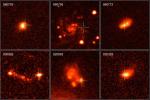 The Host Galaxies of Long Duration GRBs
17.05.2006
What causes the powerful explosions knows as gamma-ray bursts? Astrophysicists still aren't sure, but the longest duration gamma-ray bursts (GRBs) seem to involve very massive stars. A new clue indicating this was uncovered recently by a series of images taken by the orbiting Hubble Space Telescope.
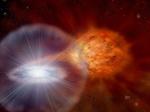 Explosions from White Dwarf Star RS Oph
26.07.2006
Spectacular explosions keep occurring in the binary star system named RS Ophiuchi. Every 20 years or so, the red giant star dumps enough hydrogen gas onto its companion white dwarf star to set off a brilliant thermonuclear explosion on the white dwarf's surface.
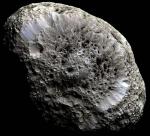 Saturn's Hyperion: A Moon with Odd Craters
28.01.2007
What lies at the bottom of Hyperion's strange craters? Nobody knows. To help find out, the robot Cassini spacecraft now orbiting Saturn swooped past the sponge-textured moon in late 2005 and took an image of unprecedented detail.
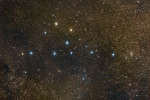 Collinder 399: The Coat Hanger
23.12.2008
Is this coat hanger a star cluster or an asterism? This cosmic hang-up has been debated over much of last century, as astronomers wondered whether this binocular-visible object is really a physically associated open cluster or a chance projection. Chance star projections are known as asterisms, an example of which is the popular Big Dipper.
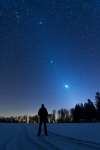 A Zodiacal Skyscape
23.02.2012
Venus and Jupiter are this month's two brightest planets. Shortly after sunset on February 20, they dominate the sky above the western horizon and this snowy landscape. In clear and transparent skies over Cherry Springs State Park, Pennsylvania, USA, they are also seen immersed in Zodiacal light.
 A Solar Ballet
15.01.2013
Sometimes, the Sun itself seems to dance. On just this past New Year's Eve, for example, NASA's Sun-orbiting Solar Dynamic Observatory spacecraft imaged an impressive prominence erupting from the Sun's surface. The dramatic explosion was captured in ultraviolet light in the above time lapse video covering four hours.
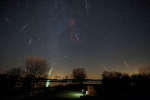 Leonids and Friends
20.11.2015
Leonid meteors rained down on planet Earth this week, the annual shower of dusty debris from the orbit of Comet 55P/Tempel-Tuttle. Leonids streak through this composite night skyview from a backyard observatory in southern Ontario.
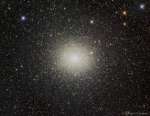 Omega Centauri: The Brightest Globular Star Cluster
27.04.2016
This huge ball of stars predates our Sun. Long before humankind evolved, before dinosaurs roamed, and even before our Earth existed, ancient globs of stars condensed and orbited a young Milky Way Galaxy. Of the 200 or so globular clusters that survive today, Omega Centauri is the largest, containing over ten million stars.
 Between the Rings
22.04.2017
On April 12, as the Sun was blocked by the disk of Saturn the Cassini spacecraft camera looked toward the inner Solar System and the gas giant's backlit rings. At the top of the mosaicked view is the A ring with its broader Encke and narrower Keeler gaps visible.
|
January February March April May June July August September |
|||||||||||||||||||||||||||||||||||||||||||||||||