
|
You entered: orbit
 Saturns Rings from the Other Side
9.06.2008
What do Saturn's rings look like from the other side? From Earth, we usually see Saturn's rings from the same side of the ring plane that the Sun illuminates them. Geometrically...
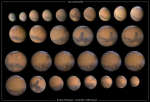 Changes in Angular Mars
14.07.2008
Does Mars always appear the same? No. As both Earth and Mars orbit the Sun, the apparent angular size of Mars changes as viewed from the Earth. Pictured above from Enschede, Holland, Mars was captured in 2007 and 2008 with 30 separate images, all taken with the same magnification.
 Omega Centauri: The Largest Globular Cluster Known
1.03.2009
This huge ball of stars predates our Sun. Long before humankind evolved, before dinosaurs roamed, and even before our Earth existed, ancient globs of stars condensed and orbited a young Milky Way Galaxy. Of the 200 or so globular clusters that survive today, Omega Centauri is the largest, containing over ten million stars.
 Saturn: Light, Dark, and Strange
12.10.2010
What's creating those dark bands on Saturn? Sometimes it takes a little sleuthing to figure out the how and why of a picture taken by the Saturn-orbiting Cassini spacecraft. Let's see. That large orb on the left must be Saturn itself. Those arcs on the right are surely the rings.
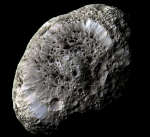 Saturns Hyperion: A Moon with Odd Craters
30.06.2013
What lies at the bottom of Hyperion's strange craters? Nobody's sure. To help find out, the robot Cassini spacecraft now orbiting Saturn swooped past the sponge-textured moon in 2005 and 2010 and took images of unprecedented detail.
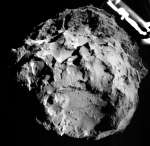 Descent to a Comet
12.11.2014
Yesterday, the first soft landing on a comet took place some 500 million kilometers from planet Earth as the Rosetta mission lander Philae settled on the nucleus of C67/P Churyumov-Gerasimenko. The landing site, dubbed Agilkia, is located near the center of this remarkable image snapped by Philae's ROLIS (ROsetta Lander Imaging System) camera.
 Unusual Plumes Above Mars
23.02.2015
What is creating unusual plumes on Mars? No one is sure. Noted and confirmed by a global contingent of amateur astronomers on photos of the red planet in March 2012, possibly similar plumes have now been found on archived images as far back as 1997.
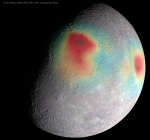 Gravitational Anomalies of Mercury
5.05.2015
What's that under the surface of Mercury? The robotic MESSENGER spacecraft that had been orbiting planet Mercury for the past four years had been transmitting its data back to Earth with radio waves of very precise energy.
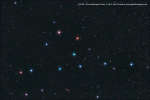 Collinder 399: The Coat Hanger
26.08.2015
Is this coat hanger a star cluster or an asterism? This cosmic hang-up has been debated over much of last century, as astronomers wondered whether this binocular-visible object is really a physically associated open cluster or a chance projection. Chance star projections are known as asterisms, an example of which is the popular Big Dipper.
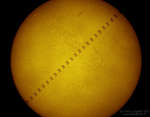 ISS and Mercury Too
13.05.2016
Transits of Mercury are relatively rare. Monday's leisurely 7.5 hour long event was only the 2nd of 14 Mercury transits in the 21st century. If you're willing to travel, transits of the International Space Station can be more frequent though, and much quicker.
|
January February March April May June July August September |
|||||||||||||||||||||||||||||||||||||||||||||||||