
|
You entered: orbit
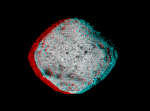 3D Bennu
12.12.2018
Put on your red/blue glasses and float next to asteroid 101955 Bennu. Shaped like a spinning top toy with boulders littering its rough surface, the tiny Solar System world is about 1 Empire State Building (less than 500 meters) across.
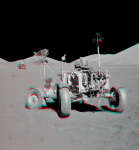 Apollo 17 VIP Site Anaglyph
16.12.2022
Get out your red/blue glasses and check out this stereo scene from Taurus-Littrow valley on the Moon! The color anaglyph features a detailed 3D view of Apollo 17's Lunar Rover in the foreground -- behind it lies the Lunar Module and distant lunar hills.
 APOD: 2023 June 19 Б The Busy Center of the Lagoon Nebula
18.06.2023
The center of the Lagoon Nebula is a whirlwind of spectacular star formation. Visible near the image center, at least two long funnel-shaped clouds, each roughly half a light-year long, have been formed by extreme stellar winds and intense energetic starlight. A tremendously bright nearby star, Herschel 36, lights the area.
 APOD: 2025 August 3 Б Milky Way and Exploding Meteor
2.08.2025
In about a week the Perseid Meteor Shower will reach its maximum. Grains of icy rock will streak across the sky as they evaporate during entry into Earth's atmosphere. These grains were shed from Comet Swift-Tuttle.
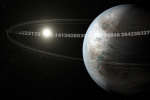 APOD: 2026 March 14 Б A Year for K2-315b
13.03.2026
Want to visit a planet that has 3.14 days in a year? Then plan a trip to K2-315b, an earth-sized planet orbiting around a cool, red, M dwarf star about once every 3.14 days.
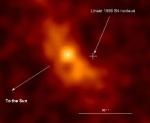 X-Rays from Comet LINEAR
1.08.2000
Why do comets emit X-rays? First discovered during the passing of Comet Hyakutake in 1996, the reason a cold comet would produce hot X-rays has since remained a mystery. On July 14, however...
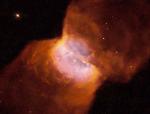 NGC 2346: A Butterfly-Shaped Planetary Nebula
28.10.2001
It may look like a butterfly, but it's bigger than our Solar System. NGC 2346 is a planetary nebula made of gas and dust that has evolved into a familiar shape. At the heart of the bipolar planetary nebula is a pair of close stars orbiting each other once every sixteen days.
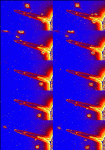 Tracking Saturn's Moons
12.05.1996
These five pairs of Hubble Space Telescope images track some of Saturn's moons as they orbit the ringed planet. A pair of images was taken every 97 minutes on November 21, 1995 with the Wide Field Planetary Camera-2, the normally bright ring system appearing nearly edge-on.
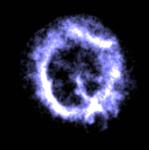 X-ray Hot Supernova Remnant in the SMC
8.12.1999
The Q-shaped cloud seen in this false-color X-ray image from the orbiting Chandra Observatory is big ... about 40 light-years across. It's hot too, as its X-ray glow is produced by multi-million degree gas.
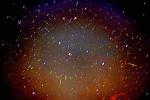 A Leonids Meteor Storm in 1999
23.11.1999
The 1999 Leonids meteor shower was not equally good for everybody. Only observers in Europe and the Middle East with clear skies near 2 am (UTC) on 1999 November 18 saw rates shoot up to a meteor every few seconds.
|
January February March April May June July August September |
|||||||||||||||||||||||||||||||||||||||||||||||||