
|
You entered: orbit
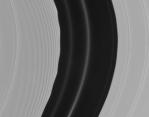 The Encke Gap: A Moon Goes Here
2.07.2004
Yesterday, Cassini became the first spacecraft to enter orbit around the gas giant Saturn, rocketing through a 25,000 kilometer wide gap in the distant planet's magnificent system of icy rings at about 15 kilometers per second.
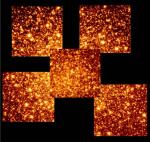 NGC 6712: Galactic Globular Cluster
25.02.1999
Following orbits which loop high above the galactic plane, globular star clusters are probably 12 to 14 billion years old - truly ancient denizens of our Milky Way Galaxy. After analyzing these new ESO/VLT images...
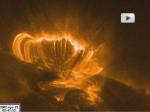 An X Class Flare Region on the Sun
6.11.2007
Why does the Sun flare? Unpredictably, our Sun unleashes tremendous flares expelling hot gas into the Solar System that can affect satellites, astronauts, and power grids on Earth. This close up of an active region on the Sun that produced a powerful X-class flare was captured by the orbiting TRACE satellite.
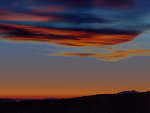 Mercury on the Horizon
27.01.2008
Have you ever seen the planet Mercury? Because Mercury orbits so close to the Sun, it never wanders far from the Sun in Earth's sky. If trailing the Sun, Mercury will be visible low on the horizon for only a short while after sunset.
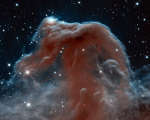 The Horsehead Nebula in Infrared from Hubble
22.04.2013
While drifting through the cosmos, a magnificent interstellar dust cloud became sculpted by stellar winds and radiation to assume a recognizable shape. Fittingly named the Horsehead Nebula, it is embedded in the vast and complex Orion Nebula (M42).
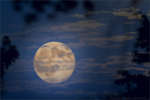 Surreal Moon
14.08.2014
Big, bright, and beautiful, a Full Moon near perigee, the closest point in its elliptical orbit around our fair planet, rose on August 10. This remarkable picture records the scene with a dreamlike quality from the east coast of the United States.
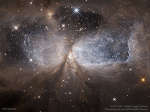 Star Forming Region S106
16.02.2016
Massive star IRS 4 is beginning to spread its wings. Born only about 100,000 years ago, material streaming out from this newborn star has formed the nebula dubbed Sharpless 2-106 Nebula (S106), featured here.
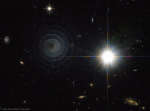 The Extraordinary Spiral in LL Pegasi
11.12.2016
What created the strange spiral structure on the left? No one is sure, although it is likely related to a star in a binary star system entering the planetary nebula phase, when its outer atmosphere is ejected.
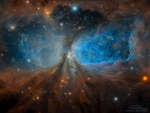 Star Forming Region S106
25.03.2020
Massive star IRS 4 is beginning to spread its wings. Born only about 100,000 years ago, material streaming out from this newborn star has formed the nebula dubbed Sharpless 2-106 Nebula (S106), featured here.
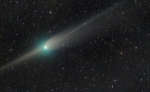 Comet ZTF: Orbital Plane Crossing
27.01.2023
The current darling of the northern night, Comet C/2022 E3 ZTF is captured in this telescopic image from a dark sky location at June Lake, California. Of course Comet ZTF has been growing brighter in recent days, headed for its closest approach to Earth on February 1.
|
January February March April May June July August September |
|||||||||||||||||||||||||||||||||||||||||||||||||