
|
You entered: orbit
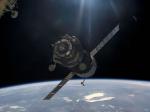 A Soyuz Spacecraft Approaches the Space Station
1.11.2005
Last month, a Soyuz TMA-7 spacecraft docked with the International Space Station. The spacecraft was launched a few days earlier from the Baikonur Cosmodrome in Kazakhstan. Pictured above, the approaching Soyuz spacecraft carried the new Expedition 12 crew to the Earth-orbiting International Space Station (ISS), as well as fee-paying spaceflight participant.
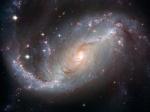 Barred Spiral Galaxy NGC 1672
18.04.2007
Many spiral galaxies have bars across their centers. Even our own Milky Way Galaxy is thought to have a modest central bar. Prominently barred spiral galaxy NGC 1672, pictured above, was captured in spectacular detail in this recently released image taken by the orbiting Hubble Space Telescope.
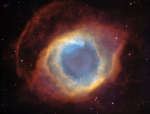 The Helix Nebula from Blanco and Hubble
12.10.2014
How did a star create the Helix nebula? The shapes of planetary nebula like the Helix are important because they likely hold clues to how stars like the Sun end their lives. Observations...
 Falcon 9 First Stage Landing
28.12.2015
The booster has landed. Spaceflight took a step toward the less expensive last week when the first stage of a Falcon 9 rocket set down on a landing pad not far from its Florida launch.
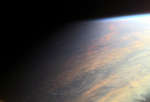 Planet Earth at Twilight
22.04.2021
No sudden, sharp boundary marks the passage of day into night in this gorgeous view of ocean and clouds over our fair planet Earth. Instead, the shadow line or terminator is diffuse and shows the gradual transition to darkness we experience as twilight.
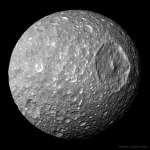 Mimas: Small Moon with a Big Crater
31.05.2021
Whatever hit Mimas nearly destroyed it. What remains is one of the largest impact craters on one of Saturn's smallest round moons. Analysis indicates that a slightly larger impact would have destroyed Mimas entirely.
 APOD: 2025 January 20 Б Comet ATLAS Rounds the Sun
20.01.2025
Why does Comet ATLAS have such colorful tails? Last week Comet C/2024 G3 (ATLAS) passed its closest to the Sun -- well inside the orbit of Mercury -- and brightened dramatically. Unfortunately, the comet was then so angularly near the Sun that it was very hard for humans to see. But NASA's SOHO spacecraft saw it.
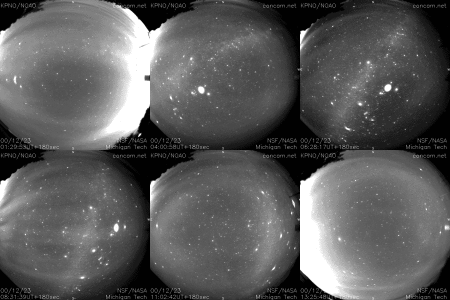 Watch the Sky Rotate
10.01.2001
If you could watch the sky for an entire night, what would you see? The above time-lapse sequence from the CONtinuous CAMera (CONCAM) project shows the answer for the skies above Kitt Peak National Observatory on 2000 December 23.
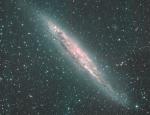 Nearby Spiral Galaxy NGC 4945
21.07.2002
For such a close galaxy, NGC 4945 is easy to miss. NGC 4945 is a spiral galaxy in the Centaurus Group of galaxies, located only six times farther away than the prominent Andromeda Galaxy. The thin disk galaxy is oriented nearly edge-on, however, and shrouded in dark dust.
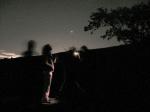 Contemplating Mars
2.09.2003
Is that really another world? Thousands of people the world over lined up last week to see Mars through a telescope as the red planet and Earth passed unusually close together in their orbits around the Sun. Reviews of Mars were mixed, with some people disappointed that Mars still appeared somewhat blurry.
|
January February March April May June July August September |
|||||||||||||||||||||||||||||||||||||||||||||||||