
|
You entered: orbit
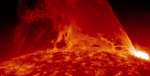 A Solar Prominence Eruption from SDO
26.05.2019
One of the most spectacular solar sights is an erupting prominence. In 2011, NASA's Sun-orbiting Solar Dynamic Observatory spacecraft imaged an impressively large prominence erupting from the surface. The dramatic explosion was captured in ultraviolet light in the featured time lapse video covering 90 minutes, where a new frame was taken every 24 seconds.
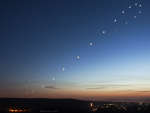 Analemma of the Moon
7.05.2020
An analemma is that figure-8 curve you get when you mark the position of the Sun at the same time each day for one year. But the trick to imaging an analemma of the Moon is to wait bit longer.
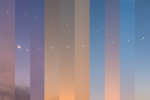 10 Days of Venus and Jupiter
4.03.2023
Venus and Jupiter may have caught your attention lately. The impending close conjunction of the two brightest planets visible in clear evening skies has been hard to miss. With Jupiter at the top, starting...
 APOD: 2024 September 16 Б Mercurys Vivaldi Crater from BepiColombo
16.09.2024
Why does this large crater on Mercury have two rings and a smooth floor? No one is sure. The unusual feature called Vivaldi Crater spans 215 kilometers and was imaged again in great detail by ESA's and JAXA's robotic BepiColombo spacecraft on a flyby earlier this month.
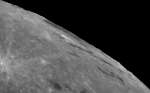 APOD: 2026 July 10 Б Western Moon, Eastern Sea
10.07.2026
The Mare Orientale, Latin for Eastern Sea, is one of the most striking large scale lunar features. The youngest of the large lunar impact basins it's very difficult to see from an earthbound perspective.
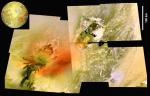 Io Volcano Culann Patera
18.12.2002
What causes the unusual colors surrounding Io's volcanoes? Io, the innermost large moon of Jupiter, is known to be the most tumultuous body in the Solar System. Approximately the size of Earth...
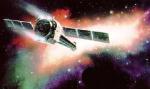 Name This Satellite
20.04.1998
Can you name this satellite? In December, NASA's third Great Observatory is planned for launch. The two NASA Great Observatories currently in orbit are the Hubble Space Telescope and the Compton Gamma-Ray Observatory, both now named for famous scientists. But after whom should the Advanced X-ray Astrophysics Facility (AXAF) be named?
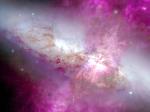 The Supergalactic Wind from Starburst Galaxy M82
1.06.2004
Star formation occurs at a faster pace in M82 -- a galaxy with about ten times the rate of massive star birth (and death) compared to our Milky Way. Winds from massive stars and blasts from supernova explosions have created a billowing cloud of expanding gas from this remarkable starburst galaxy.
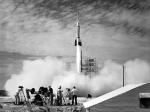 The First Rocket Launch from Cape Canaveral
4.06.2006
A new chapter in space flight began on 1950 July with the launch of the first rocket from Cape Canaveral, Florida: the Bumper 2. Shown above, the Bumper 2 was an ambitious two-stage rocket program that topped a V-2 missile base with a WAC Corporal rocket.
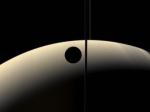 Crescent Rhea Occults Crescent Saturn
11.07.2006
Soft hues, partially lit orbs, a thin trace of the ring, and slight shadows highlight this understated view of the majestic surroundings of the giant planet Saturn. Looking nearly back toward the Sun, the robot Cassini spacecraft now orbiting Saturn captured crescent phases of Saturn and its moon Rhea in color a few months ago.
|
January February March April May June July August September |
|||||||||||||||||||||||||||||||||||||||||||||||||