
|
You entered: orbit
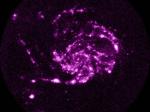 M101: An Ultraviolet View
10.06.2000
This picture of giant spiral galaxy Messier 101 (M101) was taken by the Ultraviolet Imaging Telescope (UIT). UIT flew into orbit as part of the Astro 2 mission on-board the Space Shuttle Endeavour in March 1995.
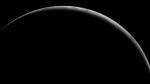 A Crescent Earth at Midnight
21.06.2003
The Earth's northern hemisphere is outlined as a sunlit crescent in this dramatic view from orbit, recorded near local midnight by the Geostationary Operational Environmental Satellite (GOES-8) on June 22, 1996. That...
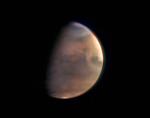 Express to Mars
18.12.2003
Hurtling toward its destination, the high resolution camera on board ESA's Mars Express spacecraft recorded this tantalizing view of the Red Planet earlier this month on December 3rd. Seen from a distance of 5.5 million kilometers, features across part of Mars' western hemisphere are bathed in sunlight.
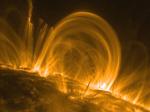 Heating Coronal Loops
14.08.2005
Why is the corona of the Sun so hot? Extending above the photosphere or visible surface of the Sun, the faint, tenuous solar corona can't be easily seen from Earth, but it is measured to be hundreds of times hotter than the photosphere itself.
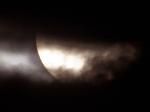 Mercurys Transit: An Unusual Spot on the Sun
14.11.2006
What's that dot on the Sun? If you look closely, it is almost perfectly round. The dot is the result of an unusual type of solar eclipse that occurred last week. Usually it is the Earth's Moon that eclipses the Sun.
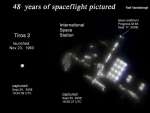 48 Years of Space Flight
16.10.2008
This year, NASA celebrated its 50th anniversary. Inspired to make his own contribution, astronomer Ralf Vandebergh set out to record images of some historic spacecraft in Earth orbit -- captured with his own modest equipment and a hand-guided, 10-inch, Newtonian reflecting telescope. One result is this intriguing composite effectively spanning 48 years of space flight!
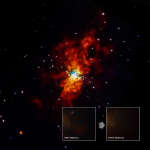 No X rays from SN 2014J
16.08.2014
Last January, telescopes in observatories around planet Earth were eagerly used to watch the rise of SN 2014J, a bright supernova in nearby galaxy M82. Still, the most important observations may have been from orbit where the Chandra X-ray Observatory saw nothing.
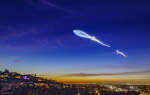 SpaceX Rocket Launch Plume over California
24.12.2017
What's happened to the sky? On Friday, the photogenic launch plume from a SpaceX rocket launch created quite a spectacle over parts of southern California and Arizona. Looking at times like a giant...
 Rotation of the Large Magellanic Cloud
16.05.2018
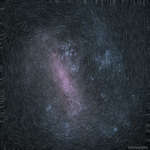
This image is not blurry. It shows in clear detail that the largest satellite galaxy to our Milky Way, the Large Cloud of Magellan (LMC), rotates. First determined with Hubble, the rotation of the LMC is presented here with fine data from the Sun-orbiting Gaia satellite.
 The Extraordinary Spiral in LL Pegasi
8.07.2018
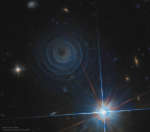
What created the strange spiral structure on the upper left? No one is sure, although it is likely related to a star in a binary star system entering the planetary nebula phase, when its outer atmosphere is ejected.
|
January February March April May June July August September |
|||||||||||||||||||||||||||||||||||||||||||||||||