
|
You entered: Sun
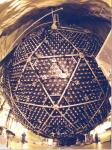 The Sudbury Neutrino Detector
23.06.1999
Two thousand meters below the ground, a giant sphere has begun to detect nearly invisible particles. These particles, neutrinos, are extremely abundant in the universe but usually go right through just about everything.
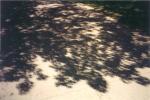 Eclipse In The Shade
13.08.1999
Near the shadow of the moon under a shady tree, dozens of images of a 1994 solar eclipse in progress are visible in this striking picture from the campus of Northwestern University in Evanston, Illinois. What creates the multiple images?
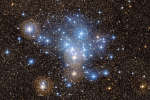 Open Cluster M25
31.08.2009
Many stars like our Sun were formed in open clusters. The above pictured open cluster, M25, contains thousands of stars and is about two thousand light years distant. The stars in this cluster all formed together about 90 million years ago. The bright young stars in M25 appear blue.
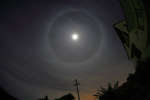 A Halo Around the Moon
20.11.2012
Have you ever seen a halo around the Moon? This fairly common sight occurs when high thin clouds containing millions of tiny ice crystals cover much of the sky. Each ice crystal acts like a miniature lens.
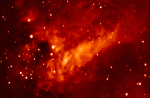 M17: The Majestic Swan Nebula
29.08.1996
What unusual eggs have been laid by this majestic swan? The star forming region above, known as Swan Nebula, is the home of hot red-glowing gas, dark lanes of dust, bright young stars and -- what are those?
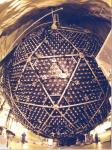 The Sudbury Neutrino Detector
25.02.2001
Two thousand meters below the ground, a giant sphere has begun to detect nearly invisible particles. These particles, neutrinos, are extremely abundant in the universe but usually go right through just about everything. By stocking this 12-meter sphere with an unusual type of hea
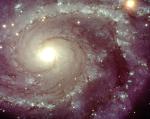 Spiral Galaxy NGC 2997 from VLT
4.08.2002
NGC 2997 is a grand design spiral galaxy. Its small nucleus and sprawling spiral arms give it a type Sc designation. NGC 2997, pictured above, is speeding away from us at about 1100 kilometers...
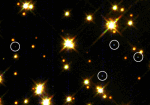 White Dwarfs Cool
10.09.1995
The circled stars in the above picture are from a class that is hard to see in the cosmos: white dwarfs. The entire photo covers a small region near the center of a globular cluster known as M4. Researchers using the Hubble Space Telescope discovered a large concentration of white dwarfs in M4.
 Star Cluster M34
11.02.2010
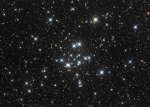
This pretty open cluster of stars, M34, is about the size of the Full Moon on the sky. Easy to appreciate in small telescopes, it lies some 1,800 light-years away in the constellation Perseus. At that distance, M34 physically spans about 15 light-years.
 Shadow of a Martian Robot
8.05.2011
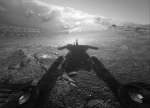
What if you saw your shadow on Mars and it wasn't human? Then you might be the Opportunity rover currently exploring Mars. Opportunity and sister robot Spirit have been probing the red planet since early 2004, finding evidence of ancient water, and sending breathtaking images across the inner Solar System.
|
January February |
|||||||||||||||||||||||||||||||||||||||||||||||||