
|
You entered: Sun
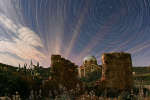 Illuminated Cloud Trails Above Greece
15.03.2010
It may appear to be day, but it's night. Those wondrous orange streaks may appear to be rays from the setting Sun, but they're actually thin clouds illuminated by the Moon as they quickly streaked toward the distant horizon.
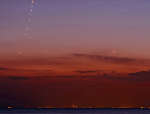 Venus, Mercury, and Moon
22.04.2010
Earlier this month, Venus and Mercury climbed into the western twilight, entertaining skygazers around planet Earth in a lovely conjunction of evening stars. Combining 8 images spanning April 4 through April 15, this composite tracks their progress through skies above Portsmouth, UK. Each individual image was captured at 19:50 UT.
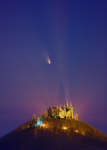 Comet Castle
22.03.2013
The broad dust tail of Comet PanSTARRS (C/2011 L4) has become a familiar sight for many northern hemisphere comet watchers, as the comet fades but rises higher above the western horizon after sunset. This view of the popular comet may seem a little fantastic, though.
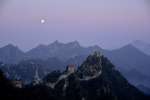 The Great Wall by Moonlight
12.03.2015
Last Friday, an almost Full Moon rose as the Sun set, over this mountainous landscape north of Beijing, China. Also near apogee, the farthest point in its elliptical orbit around planet Earth, it was this year's smallest and faintest Full Moon.
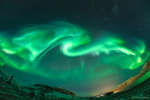 Dragon Aurora over Norway
10.04.2018
What's that in the sky? An aurora. A large coronal hole opened last month, a few days before this image was taken, throwing a cloud of fast moving electrons, protons, and ions toward the Earth.
 The Reappearance of Mars
11.09.2020
Mars reappears just beyond the Moon's dark limb in this stack of sharp video frames captured on September 6. Of course to reappear it had to disappear in the first place.
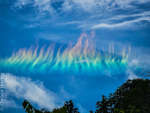 A Fire Rainbow over West Virginia
30.08.2021
What's happening to this cloud? Ice crystals in a distant cirrus cloud are acting like little floating prisms. Known informally as a fire rainbow for its flame-like appearance, a circumhorizon arc appears parallel to the horizon.
 Lunation
18.02.2001
Our Moon's appearance changes nightly. This slow-loading time-lapse sequence shows what our Moon looks like during a lunation, a complete lunar cycle. As the Moon orbits the Earth, the half illuminated by the Sun first becomes increasingly visible, then decreasingly visible. The Moon always keeps the same face toward the Earth.
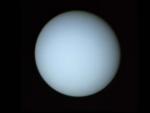 Uranus: The Tilted Planet
26.08.2001
Uranus is the third largest planet in our Solar System after Jupiter and Saturn. Uranus is composed mostly of rock and ices, but with a thick hydrogen and helium atmosphere. The blue hue of Uranus' atmosphere arises from the small amount of methane which preferentially absorbs red light.
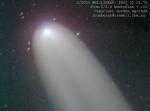 Comet LINEAR WM1 Shines in the South
4.02.2002
A new comet has brightened unexpectedly and is currently visible to unaided observers of southern skies. Comet C/2000 WM1 (LINEAR) is now reported by some observers to be at third magnitude, making it brighter -- although more diffuse -- than most visible stars. A dust tail as long as 3 degrees has also been reported.
|
January February |
|||||||||||||||||||||||||||||||||||||||||||||||||