
|
You entered: Sun
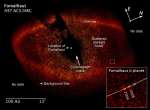 Fomalhaut b
14.11.2008
Fomalhaut (sounds like "foam-a-lot") is a bright, young, star, a short 25 light-years from planet Earth in the direction of the constellation Piscis Austrinus. In this sharp composite from the Hubble Space Telescope, Fomalhaut...
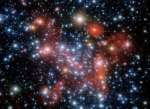 At the Center of the Milky Way
11.12.2008
At the center of our Milky Way Galaxy lies a supermassive black hole. Once a controversial claim, this conclusion is now solidly based on 16 years of observations that map the orbits of 28 stars very near the galactic center.
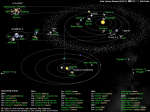 Humanity Explores the Solar System
30.04.2013
What spacecraft is humanity currently using to explore our Solar System? Presently, every inner planet has at least one robotic explorer, while several others are monitoring our Sun, some are mapping Earth's Moon, a few are chasing asteroids and comets, one is orbiting Saturn, and several are even heading out into deep space.
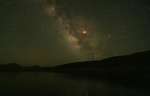 A Total Lunar Eclipse Over Tajikistan
28.01.2018
If the full Moon suddenly faded, what would you see? The answer during the total lunar eclipse in 2011 was recorded in a dramatic time lapse video from Tajikistan. During a total lunar eclipse, the Earth moves between the Moon and the Sun, causing the moon to fade dramatically.
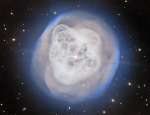 APOD: 2026 May 28 Б NGC 1514: The Crystal Ball Nebula
28.05.2026
What do you see in this crystal ball? The featured image shows NGC 1514, known as the Crystal Ball Nebula, observed by the Gemini North telescope on Maunakea, in Hawai'i. NGC 1514 is 1,500 light-years away and was discovered by William Herschel in 1790.
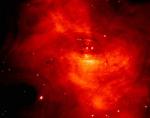 The Pulsar Powered Crab
2.06.2001
In the Summer of 1054 A.D. Chinese astronomers reported that a star in the constellation of Taurus suddenly became as bright as the full Moon. Fading slowly, it remained visible for over a year.
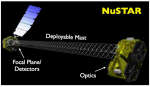 NuSTAR XRay Telescope Launched
19.06.2012
What's left after a star explodes? To help find out, NASA launched the Nuclear Spectroscopic Telescope Array (NuSTAR) satellite into Earth orbit last week. NuSTAR's ability to focus hard X-rays emitted from...
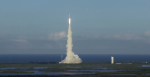 An Atlas V Rocket Launches OSIRIS REx
17.10.2016
Have you ever seen a rocket launched into the Solar System? Last month a large Atlas V rocket blasted off from Launch Complex 41 in Florida carrying the ORISIX-REx spacecraft. This robotic spacecraft will attempt to land on Asteroid Bennu and return some of its soil to Earth.
 APOD: 2025 August 22 Б A Tale of Two Nebulae
22.08.2025
This colorful telescopic view towards the musical northern constellation Lyra reveals the faint outer halos and brighter central ring-shaped region of M57, popularly known as the Ring Nebula. To modern astronomers M57 is a well-known planetary nebula.
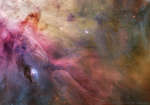 LL Ori and the Orion Nebula
18.02.2018
Stars can make waves in the Orion Nebula's sea of gas and dust. This esthetic close-up of cosmic clouds and stellar winds features LL Orionis, interacting with the Orion Nebula flow. Adrift...
|
January February March April May June July August September |
|||||||||||||||||||||||||||||||||||||||||||||||||